
Let’s Outline a 9-Part Transformative Sales Email Series or Private Podcast to Help You Sell Your Program
A rule I operate by (and maybe you do too?) is that if you’re gonna do the hard work of creating a meaningful program or product that is important to your business and your clients/community, you should have at least two major ways you generate sales of it . . . and at least one of those ways shouldn’t require additional time and labor from you or a magical team of people.
We’ll cover these in a sec; don’t worry. 👍🏽
Which is what we’re talking about today.
We’re going to get into a 9-part sales email series (or 9-episode private podcast) you can create to help sell your program. This sales series is different from an email course, opt-in, “freebie,” or “lead magnet” you might offer.
It is designed to sell your offer by making sure your best-fit clients are making a fully informed decision. You’ll get what I mean in a moment.
But first . . . I want to earn your enthusiasm or buy-in on this whole “sell in a way that doesn’t require sales calls and arguing against objections” thing.
Let’s start here:
If you’re considering buying a how-to book, you generally don’t need to get on the phone with the author or attend a live class they’re teaching to make your purchasing decision, right?
Maybe that’s partly because of the price, but it’s also heavily related to the fact that you basically know what you’re gonna get when you buy the book—between the book cover, the book description, and maybe the table of contents, you get the gist.
And you can estimate that you’re getting a fair exchange in value for the money you’ll spend . . . without grilling a sales person with questions about the book.
So you buy it. Read it. Take your time with it. Make notes as you’re going through it. Whatever works for you. You’re familiar with how to use a book, so it doesn’t intimidate you to buy it and use it on your own, right?
And, if that’s the case, I have two important follow-up questions:
Are there other information products or services for which you (and likely your best-fit clients) don’t need a sales call or live online tours of the product to make a purchasing decision?
-and-What type of content and experience (other than someone linking to a sales page in the hopes that customers will buy) do you need to make an informed decision? What do you think your clients need to make a decision they’ll be happy about?
Your experience may have already taught you that you can create many different things to do this job . . . the job of a sales person—educating your client, helping them feel understood, taking them behind the scenes of your product, and anticipating & answering their important questions.
But, in the event that you haven’t come across or used many alternative ways. Allow me to offer a small list.
If you sell strategic coaching, consulting, or meaningful education products, here are a few experiences you can create to replace a sales person (or sales calls) in your business:
A pre-recorded educational class, accessible online
A pre-recorded interactive workshop or live online workshop where you take people through a process or framework and help them apply it—I’ve been hosting a paid one of these every month for the last few years and nearly 100% of my clients for deeper programs come from these workshops
An engaging and radically helpful sales email series or private podcast (5+ emails or episodes, delivered over time to educate and support your community as they make their purchasing decisions on your meaningful product)—hint: this is what we’ll cover in more depth today
A white paper, guidebook, or other eBook, designed to communicate your problem-solving approach and differentiate it from other solutions your clients may have tried
A special challenge or event series (ex: Get Back to Yoga Week, 10 Days of Journaling to Heal, or some other mini online conference or other type of event)
A pre-recorded or live virtual “open house” or “campus tour” type of experience; similar to how prospective college students might tour a potential university or how home buyers might visit a house that’s on the market and move through it, imagining themselves in it
And more
The thing these assets above have in common is that once you set them up, they require little to no time (from you or anyone else) to maintain.
I’ve been selling services, products, and programs online since about 2011, and I have used every single one of the experiences above to sell programs that cost 4 figures and courses/books that cost 2 to 4 figures. I’ve even used some of them to help me sell 5-figure services, and I’ve helped a few of my clients (consultants and strategists) do the same.
I want to be clear though. I don’t mean to dissuade you from still using sales methods that do require time/staff, if they work for you. You might do things like:
Host regular 1:1 sessions or office hours where you sell your work
Sell through asynchronous chats or consults, using software like Voxer, VideoAsk, WhatsApp, or even Instagram DMs
Offer customized audits or assessments, after which you invite people into specific programs or services
Etc.
These are valuable things, so of course, keep doing them if you like them. I simply want to encourage you to add one of the less time intensive options to what you offer.
And today, as I mentioned, we’re diving into the transformative sales email series or private podcast from the first list above 👆🏽, so you can judge if it might be a good fit for you. Or, if you already know it is a good fit for you, you can use this guide to get some ideas for the emails you’ll send.
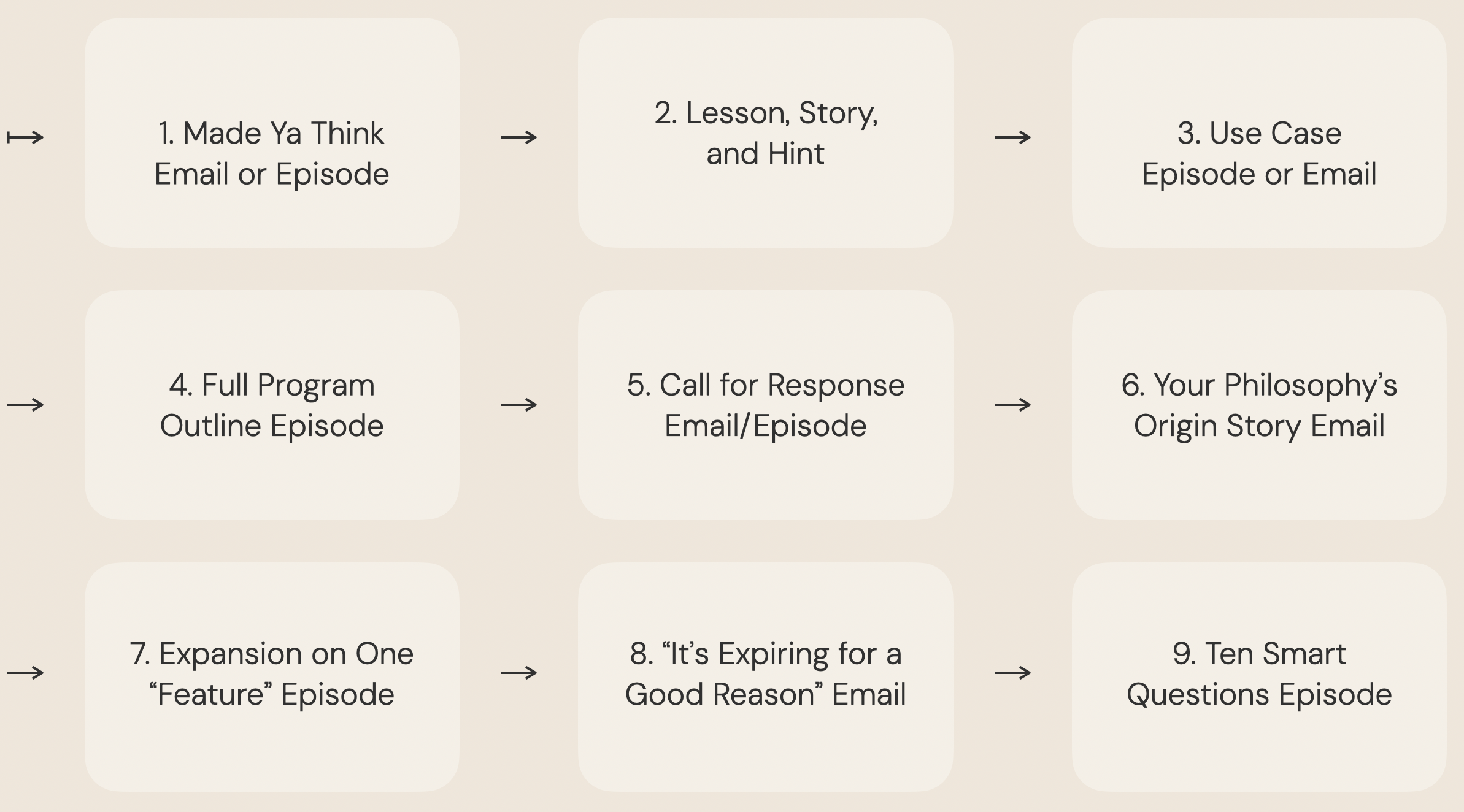
Let’s outline a 9-part email series (or a 9-episode private podcast) that you can create to help you sell your strategic coaching, consulting offers, or transformative programs/courses.
These 9 emails/episodes will help provide supportive perspective-shifting ideas for your clients to mull over, give them the “table of contents” for what you’re selling, answer (hopefully) all the questions they have before they buy, and (best case scenario) craft a powerful storyline for your customers that they can imagine themselves in 💃🏽.
Over the years, I have found myself returning to these 9 powerful emails and episodes (that work in every niche I’ve tried them in—from yoga and non-toxic living to business and publishing), and I hope you find them helpful too.
Three options (before we begin) for how you can use these emails or podcast episodes:
You can use them as 1-off sales emails you send out, or 1-off episodes you drop into your main, public podcast. If you use them this way, simply pick and choose the ones you feel fit your needs most and go for it.
You can use these as a part of a time-specific launch email sequence or private pod.
You can turn these pieces into an evergreen email series or private podcast (meaning: it is always running in the background, using software like Kit* or HelloAudio*—my two faves) and:
Then tack the episodes/emails on to the end of a “lead magnet” or opt-in you already offer. Or . . .
Drop them into your “email runway.”
An email runway is something I encourage almost all of my clients to create. It’s an email series you keep running in the background after someone first joins your email list. It might be 6 months worth of emails (2 to 4 per month), or longer. One of my clients is up to 60+ emails (that send out 1 per week), so even if she doesn’t take the time to create new emails, for at least 14 months after someone joins her list, they get a helpful email every week. Or . . .Straight up offer the evergreen email series/podcast as a way for people to learn about your deeper offer. Ex: “Interested in my financial coaching for couples? Sign up for my private podcast called Your Best Money Match, and I’ll tell you all about it . . .”
When you offer the sales series as a standalone asset, your people sign up knowing they’re going to receive 9 emails over [9 days? 2 weeks? a month? your choice] to learn more about your paid offer . . . it’s not a surprise when they’re pitched your product. This option is cool because, for the most part, only really interested people sign up.
Okay, let’s get started with the 9 assets.
Note: I’ll use the words “email” and “episode” interchangeably below, since you can create each piece as either an email or a podcast episode. Also note: One of the best sales sequences I’ve ever set up had both—after you signed up, you got the emails (spread out by a few days), but you also got a link to download the private podcast . . . and a separate link to go through the series as videos, if you wanted/need that.
The formats are up to you; the assets below work either way.
—
1. The “Made Ya Think” Email
I can’t say enough about the value of starting off a sales sequence or podcast with a Made Ya Think episode. In a Made Ya Think piece, you will either challenge your reader’s or listener’s assumptions on a key part of your topic -or- you will present and defend a tenet or view you hold in your industry that is uncommon but powerful.
When you cause a person to stop scrolling, clicking, and moving mindlessly through their inbox or social media, and you get them to really think, assess their beliefs, and open up to new possibilities, you create a memorable experience.
As an example, I sent a sales email series to my entire list several years ago 👆🏽, and I got comments on the Made Ya Think email in that series for yearsss after I sent it. Not joking.
In the email, I explored how a popular quote going around social media (mainly as cutesy Instagram images—”You have the same 24 hours as Beyoncé”) was very misleading. I broke down the math on how many people Bey probably has working for her at any given moment to “prove” that she actually had more like 1,000 hours per day.
The email introduced things that the rest of us mere mortals can do to gain back more hours in our days when we can’t necessarily hire a 50-person team. It was a “make you stop and think” moment that people loved. For some readers, it helped them reconsider a phrase (that they had accepted) and find a healthier position. For others, the email validated something they already felt and it backed their feelings up with helpful new words and math.
Some questions to help you find a theme for your Made Ya Think email (and some example episode themes or titles):
What’s a moment in your work/industry when you couldn’t use your “inside voice” or “beat-around-the-bush words” anymore and just had to be very blunt? What was the realization or issue?
Ex: “Why I think it’s dangerous for new moms to read books or follow influencers who say [this harmful but commonly said thing].”What’s something you used to believe about your topic or industry but no longer believe? What experience changed your mind?
Ex: “Once I connected my spending habits in my 30s and 40s to [this specific root], my self-trust and bank account balance grew—modestly at first, but then . . . wildly.”What’s a common phrase or piece of advice in your field that is everywhere but is misleading? Something that hasn’t been picked apart and investigated? Something that needs to be dismantled because it is dangerous or problematic when taken at face value.
Ex: “The memes lied. You do not have the same 24 hours as Beyoncé. But there are ways for us to ‘create’ more time.”
And, here’s a simple outline you can follow to create your Made Ya Think podcast episode or email:
Introduce the contrast in the title and first few seconds of the piece. Without being annoying and recanting what you say later in the very same pod episode or email.
Note: The high contrast statement you start with might either be some true type of controversy/danger or it might be something that offers a totally new connection/disconnection that will really serve your best fit client. Ex: “What if the procrastination and fear around writing your first screenplay is actually proportionate to the impact it will have?”Be clear that something’s amiss or that there’s a hidden opportunity (like a secret room in a video game). You’re hinting that it’s not to their benefit to think the old way anymore.
State the enemy/old way or thought and let them know you’re dismantling it.
Dismantle the old way of thinking. This is where you make your full argument.
Introduce or reinforce the new thought. Encourage them to explore it for themselves.
Connect this thought with the program you’re selling and with your specific CTA (call to action).
Pro tip: When you write an email or share a public podcast episode that has noticeably more engagement, reactions, or results than normal, ask yourself if it might be a good candidate for a Made Ya Think episode. Then, consider making that email part of an evergreen sales email sequence or private podcast that’s always running. That’s what I did with my Beyoncé email. It was a 1-off email that I took and made a part of an evergreen sales sequence.
2. The Lesson, Story, and Hint Episode
The bulk of this episode can either be a lesson with a side of story, or a story with a side of lesson. The former means you focus on the points of your lesson with mini story moments woven in. The latter means you share clear takeaways and action steps during or after your story (which is the focus).
This email will also contain a hint or trailer of the program or product you have created for your reader. But, the catch is, they won’t be able to buy it yet . . . which will increase their curiosity about it.
Examples:
You might send out a lesson on “5 Ways to Adapt and Evolve as a Portrait Photographer (in the Midst of a Pandemic).”
You can include a side story of something meaningful that happened to you that caused you to learn the lessons shared in the email.
-or-
You can share something powerful you or a customer achieved after incorporating one of the lessons.
Then, you can include a hint about an upcoming 4-week group program for pro photographers who want to pivot and evolve. 📸
-or-
You might send out a story with the subject line “My month without sugar . . . not what you’d expect.”
In it, you might share your personal experience of eliminating any added or processed sugars from your diet for 30 days.
Your story might include takeaways that people can implement immediately, but it also might end in a hint that you decided to not eliminate added sweeteners entirely. And that you have a cookbook and workshop coming out next month on low-sugar breakfasts and desserts. 😲
This email will often include a short “preamble”—where you remind people of the amazing offer you have going on at the moment. We've included a real-life example below.
I like to use preambles (at the beginning of my emails) and P.S. lines (at the end of my emails) to highlight my product or service . . . because . . . people who aren’t interested in the offer, can still easily see there is a lot of lesson/value, but people who are interested, are quickly reminded that the product is available at a special price.
Some questions to help you find a theme for your Lesson, Story, and Hint episode:
What’s a tactic or tool people keep misusing, misunderstanding, or overvaluing in your field? What do you use/do in its place? How does what you do work? Why does it work better for a certain type of person?
3. The Use Case (or Case Study) Email
This email shows your potential customers how a real-life person (whether you or one of your other customers) has used your service. In it, you'll share how they transformed a certain area of their life, business, health, etc.
If you don’t have past customers to create a case study with, you can share “use cases” instead. These are helpful breakdowns of how certain people could use your program. Readers will understand how it applies to them and what they can hopefully transform or improve with your help.
Examples:
We have lots of case studies from clients who have gone through our program on launching and selling online workshops. People who’ve created their own online events and sold 12, 20, and 50+ spots on their first launch.
We could either take one person’s story and create a case study and email around it, or include results/takeaways from multiple people’s stories in one email. The latter approach will help our readers find a person they can really relate to in our email.
-or-
Let's say you want to write some sales emails for courses or events you offer on yoga. Specifically, courses for neck, back, and hip pain relief.
But, let's say that you haven’t sold the course yet and therefore don’t have testimonials and case studies. Enter the "use case" email.
In this sales email, you can share details about:
how someone who works at a desk every day can use your course and
what someone who is hunched over clients giving massages or providing beauty services should prioritize and do within your course, and/or
the areas that athletes should pay attention to inside your course and how they might incorporate it into their daily routines
Email segmentation pro tip:
You can make your use case emails even more powerful by segmenting the people on your list.
You can ask them a question (such as: Which statement describes you best? ___, ___, or ___) where what they pick and click adds a “tag” to their contact info in your email marketing software (like ConvertKit*).
These segmented tags will help you send use case emails that are specifically designed for the person’s unique position.
So, in the online yoga teacher example above, you’d have:
one whole use case email that goes out to athletes
another one that goes out to people in the beauty/wellness services industry
and lastly, one that goes out to people who work in offices at a desk all day.
In the real-life example below, we sent out an FAQ sales email that had 3 options someone could click to best describe their situation. Based on what they clicked, they got 1 of 3 follow-up use case sales emails a few minutes later.
Note: You can also create segments by tagging people based on how they initially sign up for your list.
Example: You’d send a different use case email and set of examples to the person who signed up for a video series on yoga to help rehab from an injury than to people who downloaded your PDF on relieving pain from tension headaches with yoga.
4. The Full Program Outline Episode (a.k.a. the ultimate sales email for courses or offers with lots of individually valuable parts)
This email is often the first email in a sales series to fully lay out your product.
What is the substance of your offer?
And what are the individual components that make up your offer? Why should your potential customer care?
What can people accomplish or transform as they use each part of the product (ex: modules, workbooks, live sessions, templates, meetings, etc.)?
In the value stack email, you will individually value the major parts of your offer. And then add them together. This will give people a better picture of the full worth of the program. All while communicating why its current price is so amazing.
You can do this in your sales email in a similar way to how you may see it on sales pages.
In other words: you can literally just add up the value of the individual parts directly in your email. This allows you to explain each part in more detail and show your customer they're getting a deal on the workshop, course, services as a whole.
This email is truly irreplaceable in a launch email sequence for your workshop. Or as a part of an evergreen sales email sequence for your program.
5. The Call for Response Email
The point of this email is to start a conversation that lets you learn more about your potential customers. Not all sales emails for courses/workshops/services need to have "Buy now!" as the primary call to action.
The idea for this email is that you send something your customer will feel compelled to reply to. Something they have strong feelings about. Or something they're anxious to share their stories/questions for.
This doesn't mean they won't also buy your product. The deeper connection they feel with you and your content after this email will actually help with that.
Examples of Call for Response sales emails:
A yoga teacher selling a course for newbies might invite people to share their worst, or best, yoga class experience. The instructor may do this by telling their own story in the email about their first time trying yoga.
A novel writing coach who is selling a workshop on creating more engaging dialogue may invite people to come share their best dialogue (under 100 words) in a subreddit or Facebook Group hosted by the coach.
A dating and relationships author who sells a short eBook on the art of apologizing and forgiveness (as well as a high-end coaching program on better communication) might invite people to DM her with the one thing they wish they could go back and tell their 10 years younger self.
You can get creative and fun with what you ask for, or it can be a more serious request. Again, not all sales emails for courses/other products need to ask for the sale right away. This email can link to the sales page, while also encouraging a response.
Once they respond, you have the potential to learn from them, and know what they truly need. You can also guide the conversation toward the best service/product you have to offer for their unique situation.
Hint: in your email, you can call for a 1-on-1 response or a type of response you can scale up.
Option 1: Invite each person to respond to you 1-on-1.
You can invite people to reply to your email, or DM you on your favorite platform if you prefer.
Option 2: Invite each reader to respond in a group space.
You can ask people to respond in a Facebook Group or subreddit you run. Or you can invite people to comment on an Instagram post, blog post, or YouTube video instead of replying via email. This way the convo is public and can involve other audience members.
This is one of our favorite options. We will sometimes open up replies or mini-coaching threads in our online communities or IG posts, so that people benefit from the stories, questions, and answers other people leave as well.
Either way you go, the people who actually respond will form a deeper connection with you and your brand.
6. The Origin Story (of Your Philosophy) Episode
7. The Expansion on One “Feature” Email
Whereas most sales pages and sales emails for courses/workshops provide a “zoomed out” view of a product (meaning: they give an overview and try to help potential customers see the big picture), this email type zooms in on a single part of your offer and shows the benefits, applications, and “why” of its design.
You’ll want to pick an element of your offer that your ideal customer will see the value in and be excited about, or will simply see the necessity of. Think about maybe highlighting just the:
Online community that comes with your product. Who is there? What types of conversations happen? How can customers use it? What are some wins that other customers have reported from using it?
Bonus group coaching calls and how action-oriented they are.
Single, time-saving template that your product comes with.
Etc.
We often create “highlight” sales emails like this that share the pop-up group coaching weekends that we add to our products at times. They always drive a surge of sales and are one of the most fun and transformational bonuses we provide 💃🏽.
In the screenshot below, you can see part of a sales emails we use for The 8-Day eBook Blitz. It goes into detail about the book launch parties (a single element) that are a part of our program.
8. The “It’s Expiring for a Good Reason” Episode or Email
This is one of the most powerful sales emails for courses. You can use it to incentivize your customer to act now ⏰, rather than waiting until later.
The "It's Expiring" email communicates to your potential customers that the price, or bonuses, or even a specific feature of your workshop or course, are expiring (for a sensible reason).
You may (legitimately) cause this "scarcity" or urgency, because:
You are only offering a certain number of spots in your product/program so that everyone can get tailored attention.
Or, maybe you have a special bonus of a free 1-on-1 call but can only offer it to the first 10 people who join.
You might be hosting an event live and therefore have a cutoff date.
Or, maybe you’re offering a "beta" (test) version of your exclusive program. And due to it's "beta" nature, you're offering a discount. But, the next time it’s available it will be at its regular price instead of at the “founder’s edition discount” price.
You get the picture.
Hint: if you use ConvertKit* (one of my favorite email software providers) you can now add countdown timers into your emails and landing pages.
9. The 10 Smart Questions Email
Words.
Okay, so, those are the 9 irreplaceable sales emails/episodes for courses, workshops, coaching programs, etc. that you can use in a 1-off fashion, as a part of a launch, or as a part of an evergreen sales sequence.
Some ideas to get you moving now (instead of making this just something you bookmark and get to later):
If you had to do it . . . which one of the emails above do you think you could create a solid first draft for in the next 24 hours?