
Design a “Draft in Public” (DIP) Project to Build Your Book and Platform at the Same Time
Designing, writing, and publishing a “shelf stable book”—one that is able to sell for years and years and years—is a big project. But, if you can draft that book in public (or, at least part of it), in a way that helps you build your author platform and draw in future customers/readers at the same time, you’ll be doing yourself a huge favor.
And that’s what this mini guide is all about.
But before I ask you to read it, I should briefly explain my own experience with drafting my first book in public . . . a book that went on to become a “required read” at multiple colleges in the U.S.—unbeknownst to me, until students started emailing me with questions. 🤣
How I drafted my first book in public . . .
Hey, I’m Regina Anaejionu (en-ay-john-oh). And in 2012 I had virtually no online platform. My business at the time (graphic design services) was made up of clients who were referred to me and a few clients who found their way to my website thanks to old school SEO, search engine optimization.
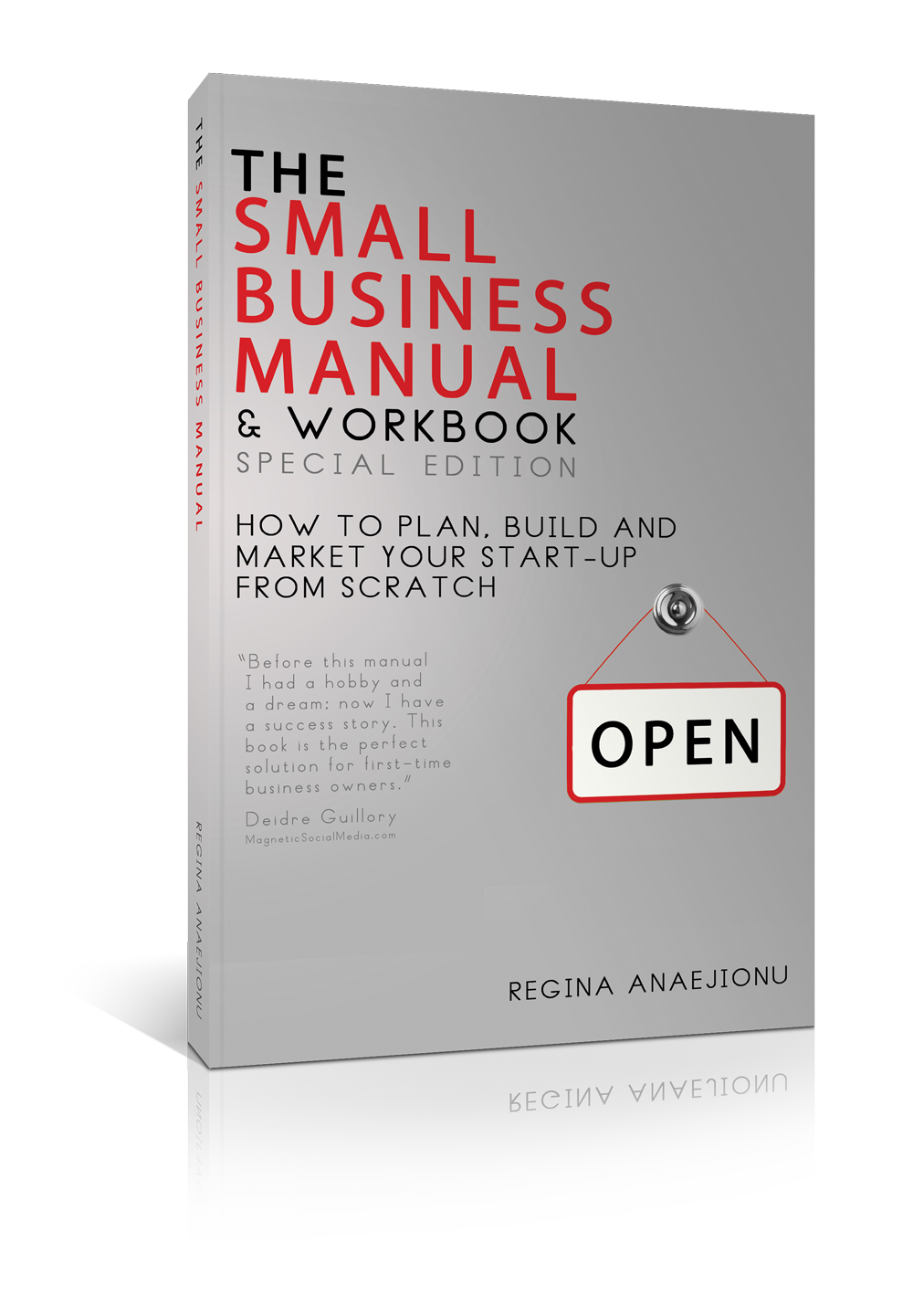
I wrote a book, The Small Business Manual, that drew from my experience both starting in-person businesses in Austin, Texas and launching & running a successful online freelance business—where I did invitation design, logo design, and web design. The book helped people learn about the various structures they could choose for their businesses, understand types of insurance they might want/need, calculate cost of goods sold, figure out how to set up websites for their businesses, and more.
It was like a small business 101 guide that I began to compile after taking dozens of coffee meetings to answer questions from friends and friends of friends.

But about the drafting it in public thing . . .
In one sense, the first drafts of my book were all those individual coffee meetings where I shared everything helpful I could think about in regard to starting a successful business. My frustration with those meetings was that I would leave them and realize I’d forgotten to tell the person X, Y, or Z thing that they might need to know later.
It got me thinking that maybe I should turn the materials into a course or a book, so I could hand someone a complete package/guide. It was 2012, way before online courses were as common as they are now, so I did the first thing I could think of—searched for where I could teach in-person classes. Within weeks, I was signed up to teach at the University of Texas at Austin in their “Informal Classes” program.
I taught an “Intro to Starting a Small Business in Texas” class and a class on building your first WordPress website. These classes were where I really started to draft my book. I turned everything I wanted to teach into dozens and dozens of pages of materials and printed out binders for the adult learners who paid for my classes.
I also wrote articles (and made very low-quality videos 🤣) about the topics in my classes and put them on my website, so students could revisit them long after their 3-week class was over.
Eventually, the in-class binders were almost 100 pages, and the website articles/videos (that I thought only students were visiting) were getting hundreds of visitors each month. I realized it was time to formalize everything as a book.
I challenged myself to create the book’s chapters as more polished articles/videos or class materials first, so I could update my writing based on the questions/comments my pieces got. I did that until at least 70% of book was done, then I finished writing, designing, and publishing the book.
I self-published The Small Business Manual in 2013, and between students from my in-person classes buying it, people who found my website purchasing it, and visitors to Amazon.com finding it and grabbing copies, it started to sell reasonably well every month.
And, as I mentioned, it even got picked up by a few of colleges in the U.S. as one of their required textbooks.
I followed a similar process for my second print book, which was a workbook and an editorial planner for bloggers, and it went on to bring in over $100,000 USD in profit from book sales in its first few years.
I don’t think drafting these books in public was the sole driver of their impact, sales, and success. But I really believe that the DIP (draft in public) process helped me make better books, build a much larger and more engaged platform than I would have otherwise had, fill out the interest list of readers before the books were even out, and more.
I’d like to take you through how to create a DIP project for your own platform and book.
A Draft in Public (DIP) Project is your way to build the right book and platform at the right time.
To be more specific, it’s a structured publishing project (that can include audio, text, video, or hybrid pieces) that you use to help draft and market a book. Some of the pieces you create as you DIP will be exact excerpts/chapters from your book. Some pieces you’ll publish and get feedback on solely to help you think through the book. Some pieces you publish will be more about building trust with future readers. And some will be about helping to market and sell the book.
The important things to remember are that after you DIP, your book will hopefully have:
A built-in readership—a.k.a. the people who discovered you and your forthcoming book through your DIP pieces
A stronger premise/promise, because you process each part more deeply as you form it into individual pieces; also, your book’s promise grows if you allow your ideal readers to read and give you feedback & new ideas as you write
Several long-term marketing assets already published and in place on your platform (in my case it was articles I could add to, and YouTube video description boxes I could update, to include details and links for the book’s Amazon page once it was live)
—
To help you as you choose, design, and carry out your DIP project, we’re going to cover three things in this guide:
The spectrum of DIP projects/platforms you can choose from
Ways to prompt yourself so you always know what to write as you DIP
How you might want to spread out and schedule your DIP pieces across three distinct phases
Part 1: First, let’s cover the spectrum of DIP (Draft in Public) projects you can choose from for your book.
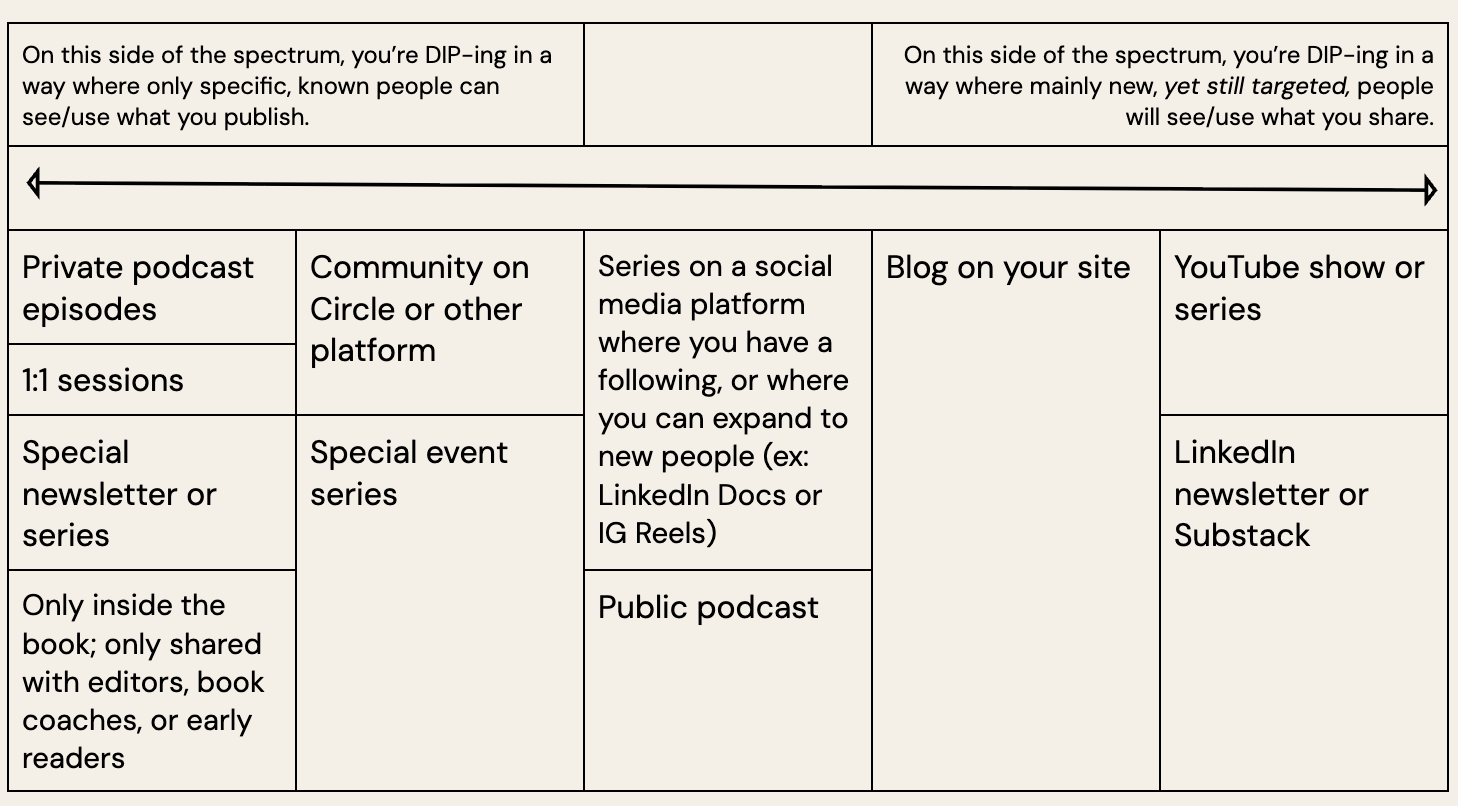
The spectrum of DIP projects ranges from slightly more “private” forms of drafting “in public” to more widespread ones. You might choose to publish in one or more of these places as you form your book over several months, or a year+.
Below is a screenshot from a workbook I created to go along with this guide. The image shares the DIP spectrum. P.S. If you want the workbook, you can sign up for it here. But I’ll tell you more about it later.
On the left side of the spectrum, we have the most private forms of drafting in public. Meaning, your DIP pieces end up in places where only specific, invited people can see or use what you publish.
On the right side of the spectrum, you have the most public versions of DIP-ing. In fact, mainly new people are likely to see or use what you share. I’ll explain more below.
—
When and what to choose from the “private” end of the Draft in Public spectrum.
If you want to be very intentional about who you invite to consume your Draft in Public pieces, this left side of the spectrum is probably where you’ll land.
Here are some options:
1. Private Podcast Series
If you’re unfamiliar with private podcasts, here’s the gist. You can create a podcast (a collection of however many audio episodes) and instead of making them publicly available/findable, require people to have a special link in order to access them and download them to their preferred podcast app. I use the software called Hello Audio* to host all my private podcasts.
When doing a private pod, you can design it a few different ways:
If you’re still kinda working out what you want your book to be about, you could create a private podcast series that explores several pressing questions you think you may want to answer with your work. Note: That workbook I told you I made for you? If you haven’t already downloaded it, it has 120+ questions you might be interested in.
—
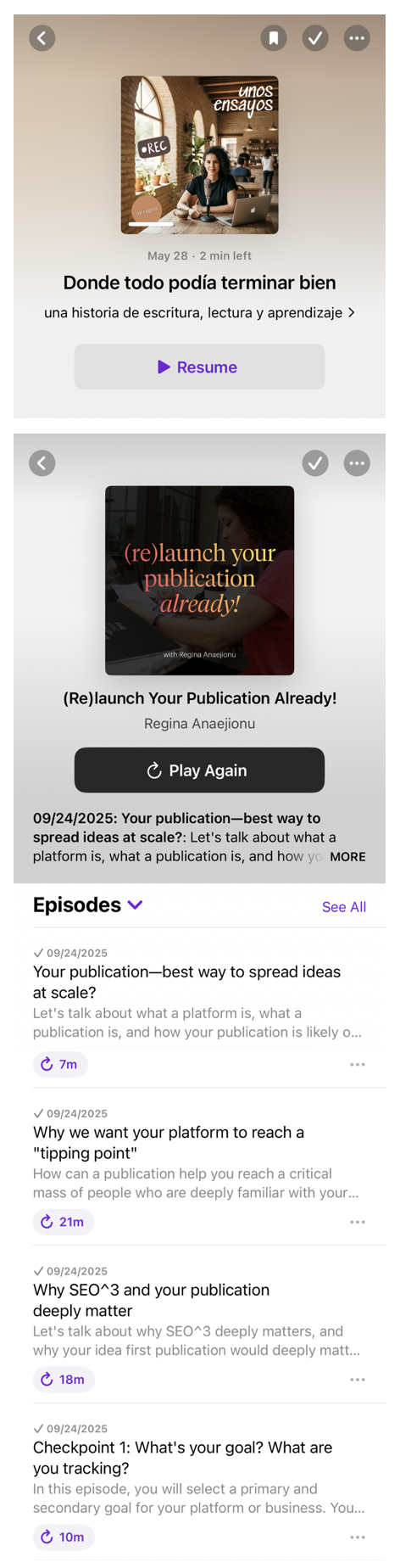
To the top-right I have an image of one of the private podcasts I’ve created in this style—it’s a series of essays (en español) that help me work through what I want to talk about.You could also develop a rough outline of your book and create individual podcast episodes for the various sections or chapters. You don’t have to share your whole book in this way, if you don’t want to, but it can be a low pressure way to get your first draft done and to share the key ideas in your book with others.
—
Sometimes I do this (a private podcast episode for each part/chapter of my book) just for me. It allows me to talk it out, then transcribe it, and work from a more full draft.
—
To the bottom-right, I have an example of a 17-episode private podcast I shared with members of a program I run. The pod is all about creating or relaunching a “search everywhere optimized” publication like a blog or YouTube channel.You could also design a “live” experience for people where every two weeks or so you drop a new episode of your private podcast (each episode could be a chunk of a chapter or a whole chapter). You could then invite people into a private community space to ask questions, give you feedback, or join you for a deep dive into the topic of the week/month. You could also invite people to email you or DM you replies and questions to each episode. This makes everything more interactive and allows you to learn how your materials are landing with people.
At the end of this section, I'll give you a few ideas on how to promote or share your private podcast with others. But for now, let’s move on to a couple other types of more “private” ways to draft in public.
2. Special Newsletter, Email Series, or Event Series
For a newsletter, email series, or special event series, ditto everything I shared above for private podcasts. You can use them to work out what you want to say, to create a little and then get feedback before refining it or creating more, etc.
3. 1-on-1 Sessions or Community Chats
If you want to hold 1-on-1 client sessions or host a themed community as your way to draft your book in public (and build the interest list for the eventual book), here are some questions to answer:
Do you want to outline your book first and then create special sessions/discussions centered around the major chapters of your book?
So for example, if you were writing a lesson-style memoir about caregiving, you might host an online community (using software like Circle, Heartbeat, or even Facebook Groups) and have discussions around the logistics and scheduling of caregiving, setting boundaries and asking for help, Medicare and Medicaid “demystified” (as much as possible), the realities of self-care when you’re a primary caregiver, and more. You might plan the discussions to match what you want to cover in the various chapters of your book.
If you plan to host 1:1 calls, will they be paid or free? And what will you primarily use them for?
Do you want to test out your material?
Do you want to talk with people whose stories and situations you might turn into case studies or examples in the book (with permission of course)?
Do you want them to primarily be teaching/planning sessions where what you share is basically your draft wording, frameworks, diagrams, etc. for your book?
Will you give community members or 1:1 clients early access to the book or to chapters as you finish them?
What is the takeaway or benefit that your clients leave with after your sessions? What do community members gain other than “yet another thing they have to log in and check on” by being in your space?
These are just a few questions to think through. But now, another question you may have is “How am I going to invite people and get people signed up for my sessions, podcast, community, etc.?”
—
Ideas for spreading your private podcast, 1:1 sessions, newsletter series, or event series to more people:
Not to be Captain Obvious 🦸🏽, but you can of course email any people on your email list, invite current clients, and/or put out an open call on social media for participants. ✅
You might also choose to have a layered approach—first, you share your podcast, event, or other resource with your best clients and get feedback and make changes, then you expand it to your full email list, and finally, you invite anyone connected with you on social media.But, if you’re open to reaching people beyond your current connections, you can also create a quick, inexpensive ads campaign to invite people to the session/series/podcast. When I do this I like to:
First spend around $100 over 5–7 days on a “Message Test Campaign” where I test 7–12 different “angles” out. These angles are points of view, philosophies, beliefs, tenets, or opinions (in the realm of the book that I’m going to write) that can be shared in just a few sentences. Each angle becomes its own individual ad that invites people to the private podcast (or the newsletter/event series, etc.).
After a few days, I assess which angles were most effective at encouraging people to click and then sign up.
I then either leave those two or three “winning” ads on and just give them another $100 or so of budget (while turning all the “losing” ads off), or I turn off all the ads, but take the winning angles and make them into their own more evergreen ads that I run with a few hundred dollars of budget.
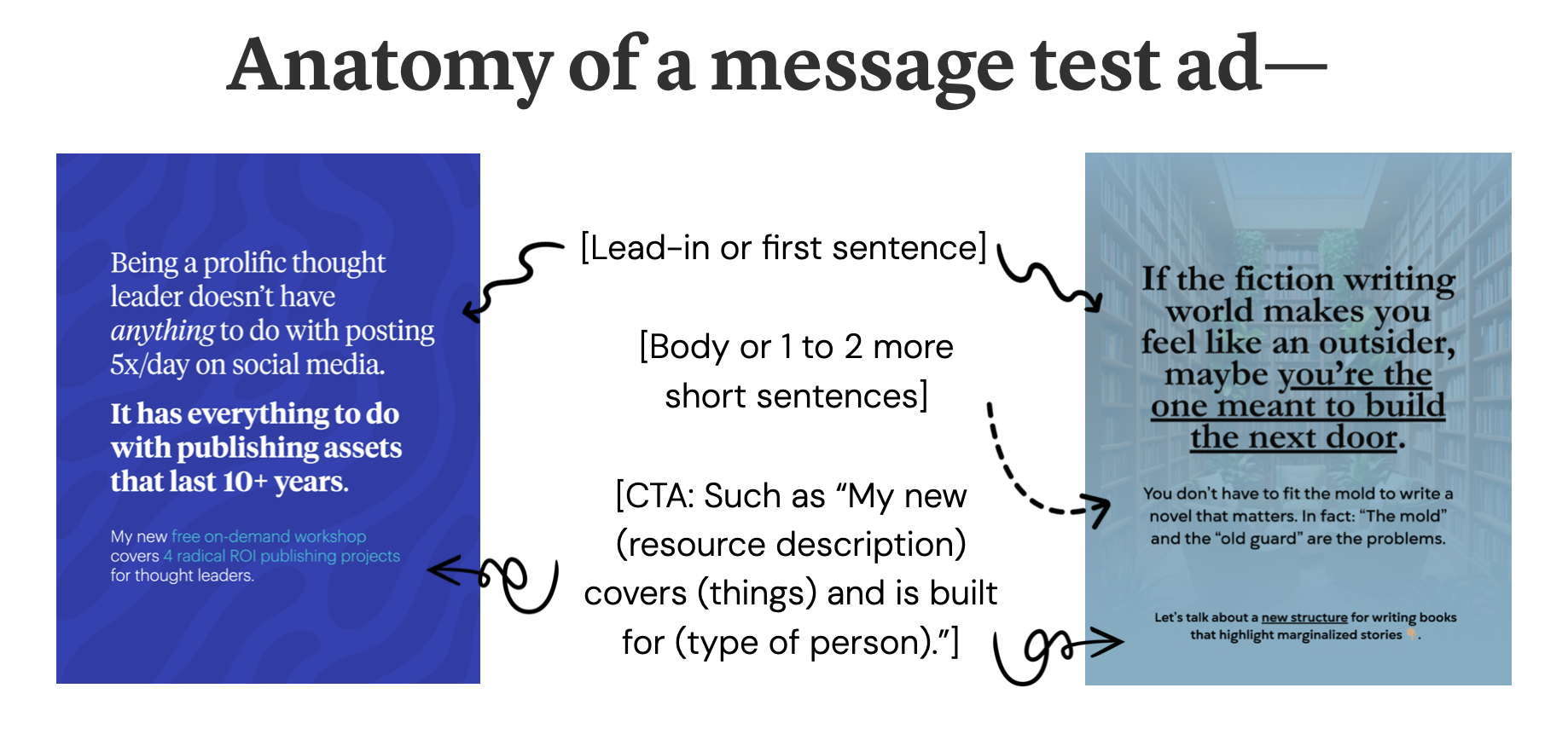
This is a screenshot from a lesson I teach on message test ad campaigns. I’m sharing it with you to give you an idea of how simple the ads can be. I typically design a plain or lightly styled background and put text on top of it. The idea is that whether you’re testing 7, 10, or 12 messages against each other, each one should be designed in the same way, so that it’s truly the message that is competing, not the graphics. For example, in a recent message test I ran, all 10 images looked like the image on the left of this screenshot.
—
When and what to choose from the middle of the DIP spectrum.
If you want publishing projects that are a good mix between getting in front of people who already know you and expanding to new people, then the middle of the Draft in Public spectrum might be your thing.
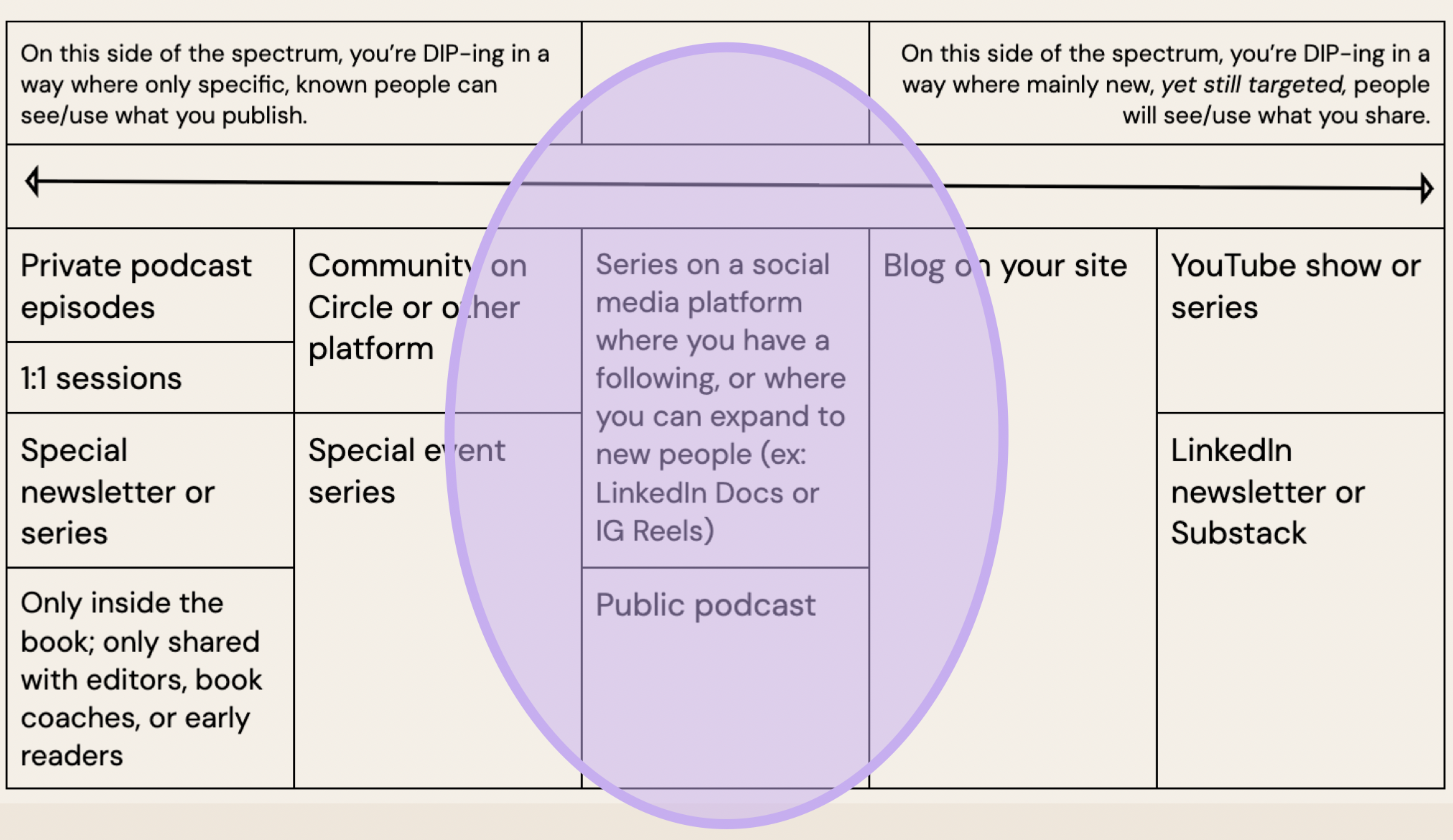
Here are a few ideas:
1. Social Media Series (on a platform where you have a following)
Whether you’re operating from your book’s outline or still exploring individual beliefs, lessons, thoughts, and ideas that you’re considering putting in your book, you can plan and execute on one or more social media series to get the material out, get people’s reactions, and build more of a platform for your work.
You might choose to create:
A connected set of Instagram carousels, LinkedIn “docs” (like carousels), or text-based posts on Threads, Facebook, or LinkedIn
A series of YouTube shorts, reels on Instagram/Facebook, or other short-form videos on social media
A series of slides (that typically expire after 24 hours) as Instagram/other “stories”
Or any other form of content on social media that allows you to create and share short lessons and stories
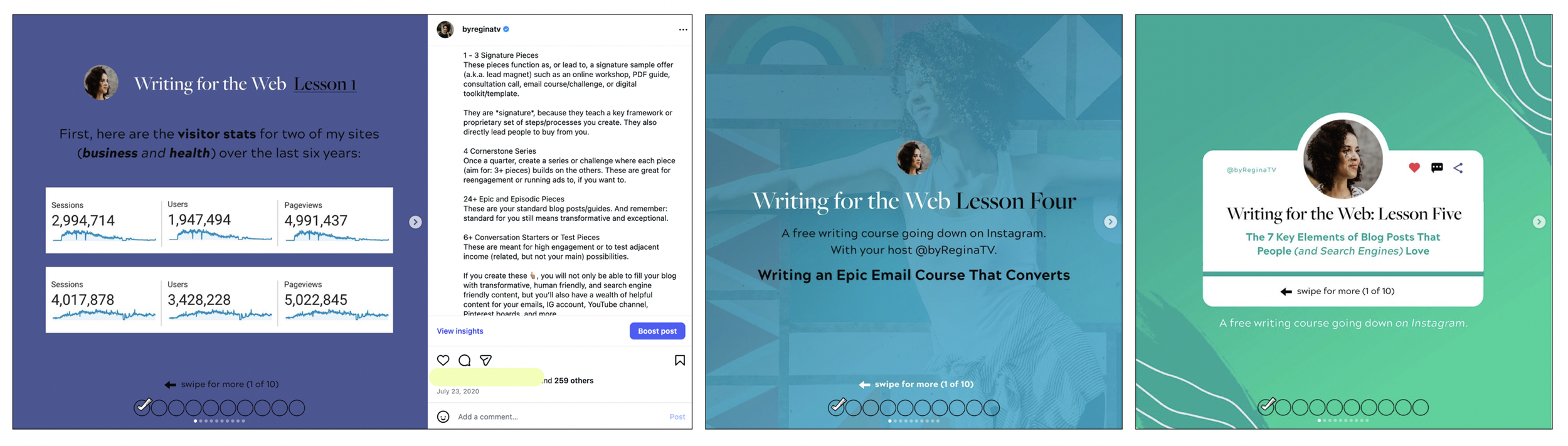
As an example above, I have a shot of the first “slides” of a few of the Instagram carousels I created several years ago when I was doing a series on “Writing for the Web” . . . something I was considering putting into a book. Each carousel was about 10 slides long (which was the maximum length at the time) and included diagrams, templates, text, images, examples, etc. that helped me share my approach to creating powerful online assets.
Because people saved, commented on, and shared these posts, they were delivered to people outside my “followers” on the platform, and my Instagram connections grew.
Nowadays, platforms like Instagram are even more set up to deliver your content to people outside your network. So, though I don’t ever recommend making social media your whole marketing plan, it can indeed connect you to new people who are a great fit for your work.
2. Public Podcast
If audio is a format that works for you and your best-fit readers, then you might want to consider creating a public podcast. If you already have one, you can simply create a series or a season of your podcast where you draft your book in public. Note: You don’t have to announce that you are drafting your book in public. You can simply make a series of connected episodes that build off of each other or belong together thematically.
Though a public podcast can stretch far and wide beyond your current community or audience, I don’t include it on the farthest-to-the-right side of the DIP spectrum (where blogging and YouTube are) because podcasts still don't have the same search/suggestion engine juice that articles and videos have.
Note: If you create a public video podcast and host it on YouTube, then I would consider that more of a right side of the spectrum project and platform. When I talk about public podcasts above, I’m referring to audio-first ones on Apple Podcasts, or other similar platforms.
If you create a public podcast, you’ll likely want to be purposeful about inviting people to it or taking out ads for it, since it’s not as optimized for suggestion & search engines. However, you will hopefully find that many new people make their way to your podcast on their own, either through recommendations, podcast directories, a little search engine love, or other means.
—
When and what to choose from the most public side of the Draft in Public spectrum (the right side).
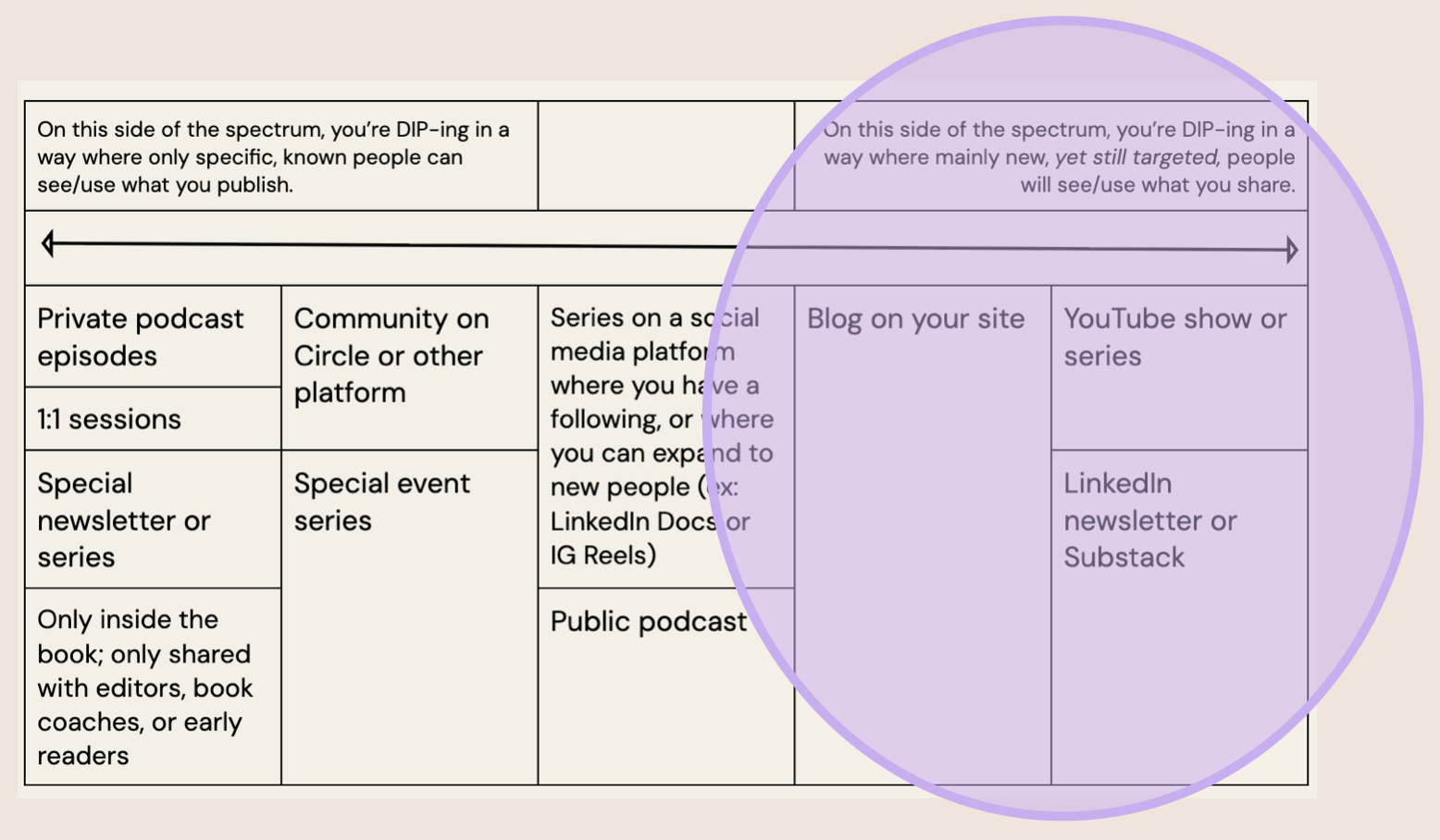
The more crystallized your ideas & stories are (that you’re putting inside your book), and/or the more you want to grow a readership & platform as you draft in public, you’ll likely be seeking DIP projects on the right side of this spectrum. These are the projects that often reach new people over people who are already familiar with you.
Here are a few DIP projects/ideas for you to judge if this might be a good fit:
1. Blog Series or Library of Articles and Essays (on your website)
This has traditionally been one of my favorite DIP projects. First because, I enjoy writing. Secondly, I like the fact that as I DIP, the assets I’m creating are already in a text-based format, designed for reading. As opposed to having audio or video files, where you might speak in a way that is a good fit for those formats, but would need to be edited to read well.
Note: Your DIP project doesn’t have to take over your whole blog or website. You can simply create a series of posts, articles, or essays that allow you to slowly work out the content of your book. You don’t have to let readers know that the posts are your way of writing a book. But, you also might find it helpful/inspiring to let people know what you’re doing, and to even have a sign-up form they can fill out to get notified when more of the book is ready.
When I DIP a book on my website, I’m typically using one of two approaches:
I’ll make a full outline for my book, and then choose the section or chapter I most want to write next, and write it as an article or essay. I will typically do this until I get to a point in my book writing (maybe 40% done or 70% done) where I know I can focus and finish it.
Or, if I don’t have an outline but I do know what I want to write a book about (ex: healing through journaling), I will challenge myself to write 20 or 30+ articles and essays on the topic, and then I will organically select the pieces that belong in my book, or that I want to expand on and include in the book.
In the era of “search everywhere optimization,” where traditional search engines might return your articles to searchers as results, and/or various AI tools might recommend your work to people, your written pieces can be found by entirely new readers. And you can still send your articles and essays to your email list, take out ads to them, or share them in a community you run, etc.
2. Substack or LinkedIn Newsletter
For Substack publications and LinkedIn newsletters, pretty much ditto everything above that I said for articles and essays on your site, with the key difference being Substack and LinkedIn have a built-in readership that will often allow your pieces to spread even further with new people than the ones hosted on your site.
3. YouTube Series and Channel
Finally, when thinking about creating a playlist, show, or series of videos to DIP your book on YouTube, we’ll pretty much ditto everything above for blog posts on your site . . . except we have to acknowledge two major things:
YouTube is a suggestion engine on top of being a search engine, which means your pieces will often get suggested to people based on their interests and not because they already follow you on the channel. This platform has one of the best setups for growth to new community members and audiences of everything I’ve mentioned today.
Also . . . the hippo in the room, if you will—when you create on YouTube, then you’re creating videos instead of articles. Meaning, you’ll be designing the material to make sense in video format. As you do this (DIP on video), you might want to plan ahead for how you’ll transition your best videos into text-based assets that read well.
—
K. So . . . we just covered the types of Draft in Public projects you might create for yourself in order to DIP your book, build a platform, and build the interest list for your book at the same time.
Keep in mind: You might actually choose more than one of the projects above to be running simultaneously. For example, you might have 1:1 sessions you host, a public or private podcast that you put together, as well as a Substack/YouTube series or articles on your site.
Part 2: Next, let’s talk about how to always know what to write inside your DIP pieces.
I’m going to keep this section simple and cover two main ways you might want to approach this. (So, this is by no means an exhaustive list of your options.)
Way #1: For when you’re still working out what you want the thesis or storyline of your book to be.
Note: You can also use this method when you’ve already worked out the premise of your book, but aren’t necessarily ready to write it, chapter by chapter.
I don't know if it will make sense to word this way . . . but sometimes, you need to just kind of write “around” the topic or story to let the most compelling parts emerge. Another way to word this is that even though you might have clear thoughts, opinions, frameworks, or story moments to share, you might find you still need to write your way through it before you’re ready to decide what goes in the book and what doesn’t.
If you’re in this position, I highly recommend choosing your DIP pieces from four terrains or areas that make up the landscape of your book:
The Book’s Sparks: These are the things that lit the fire 🔥 in you for this book, and that keep it burning while you write. These might include curiosities, threads, unresolved needs, things that bother you, or even unpaid debts you feel that you have to yourself or to others. In the workbook that I link to below, I give you 24 prompts/questions to help you explore this terrain.
The Reader’s Needs: This includes the friction, hopes, longings, and pieces of your readers’ identities and beliefs that direct their way of being in the world. You don’t create these needs—they exist long before your readers come across your book—instead, you recognize the needs, deeply. Which means a stranger can read your work and think “Wait. This is (for) me.”
In the workbook linked below, I share with you 20+ questions in this terrain.The Author’s Process: These are the things you discover, wrestle with, and overcome to write your book. This terrain is also your relationship to the craft of writing, and at times . . . your openness to co-creating with the people you are writing for. When you write pieces from this area, they are not the “still writing, send coffee!” style of updates. They are pieces you’ll create to truly share what you’re processing . . . and they’ll be a primary way that readers come to trust you and get invested in the journey with you. There are a few dozen prompts in this terrain in the workbook shared below.
The Larger Convo: These are the conversations your book starts, joins, and/or shapes. It’s the language it gives people for things they already felt (but didn’t have words for) or the things they needed articulated a certain way to understand. This is when your book is no longer just your precious project, but something people can use, journey through, argue with, quote, gift to a friend, and make changes from. I share with you three dozen prompts in this terrain inside the workbook linked below.
P.S. If you missed it, I have a free guide, here on this website, on these 4 terrains that you can read right here.
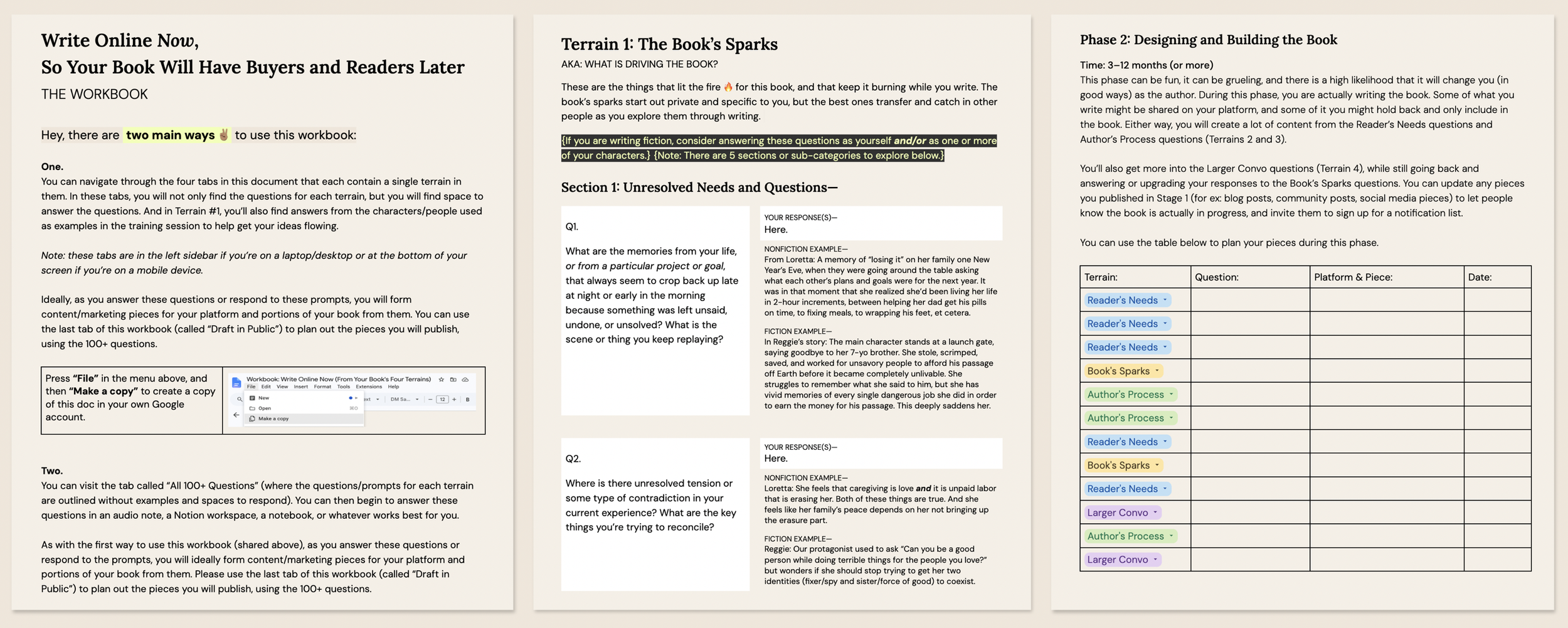
P.P.S. The “Write Online Now” Workbook I created for you supplements both the 4 terrains lesson (linked in the sentence above) and this Draft in Public lesson. You can sign up for the workbook here, if you don’t already have it.
Way #2: For after you’ve developed a working outline and are ready to tackle the book, section by section.
This method is pretty much self-explanatory:
You will make a thorough outline of your book ahead of time and select the chapter you’re most excited about writing, or the chapter you know you need to write, then you will draft it as a piece on the platform/project you chose in part one above.
You will repeat this process until you’ve either finished a full draft of the book or gotten to a certain stage (perhaps 50% done) where you’re ready to stop publishing the pieces publicly and finish the book in private before you publish it.
When you use this method, each time you publish a piece, inside the article/episode/session, you might choose to let people know that you have an upcoming book on this topic. That way, you can invite them to sign up to be notified when the book is released . . . or you can invite them to sign up for a special segment of your newsletter where they get some cool bonus related to the book or get new chapters as you release them.
—
Again, these aren’t the only two ways you can draft your book in public (and you might even choose to do a hybrid mashup of these two ways 🤯), but hopefully they give you a good DIP starting point.
Part 3: Finally, let’s go over the three phases of your “Draft in Public” project.
I’ll start by saying these phases are optional. You can use what we’ve already covered inside this guide and just get going if it’s enough for you. If you want to think through an example, organized approach to DIP-ing, then you might want to check out this section.
These phases can help give you milestones as you DIP through your book that will feel very satisfactory to reach or check off.
In Phase 1 of DIP-ing, you build the premise, readership, and platform for your book. You’ll write DIP pieces to help you figure out what the book really needs to be about, why you’re writing it, and who you’re writing it for.
In Phase 2, you design and build the book. This is the fun part and the hard part—where you use your DIPs to actually write the book.
In Phase 3, you launch and sell the book. Your book will be out in the world, adding something to the larger conversation or genre you’re entering, and creating impact and legacy. You’ll use DIP pieces to direct these conversations and create long-term marketing assets for your book.
Here are a few more details on each phase—
Phase 1: Building the Readership and Platform
Time: 1–3 months (or more)
In this phase, you’re not only building your platform, but you’re also figuring out what the book really needs to be. What questions are you answering with the book (whether you’re writing fiction or nonfiction)? Who do your characters need to be (if writing fiction) and who do they need to become for your story to have meaning? Who are you and who do you need to be as the author to write this book?
—
In Phase 1, if you’re using the Four Terrains section of the Write Online Now Workbook, you'll pull a lot of your prompts and questions from the Book’s Sparks (Terrain 1) and Reader’s Need (Terrain 2), but can always draft pieces from the other terrains as well.
In the workbook, I provide you a table (like the one below) to plan your pieces during this phase. You can also choose to build out a similar table/database in Notion (or the tool of your choice) to help you manage your DIPs.
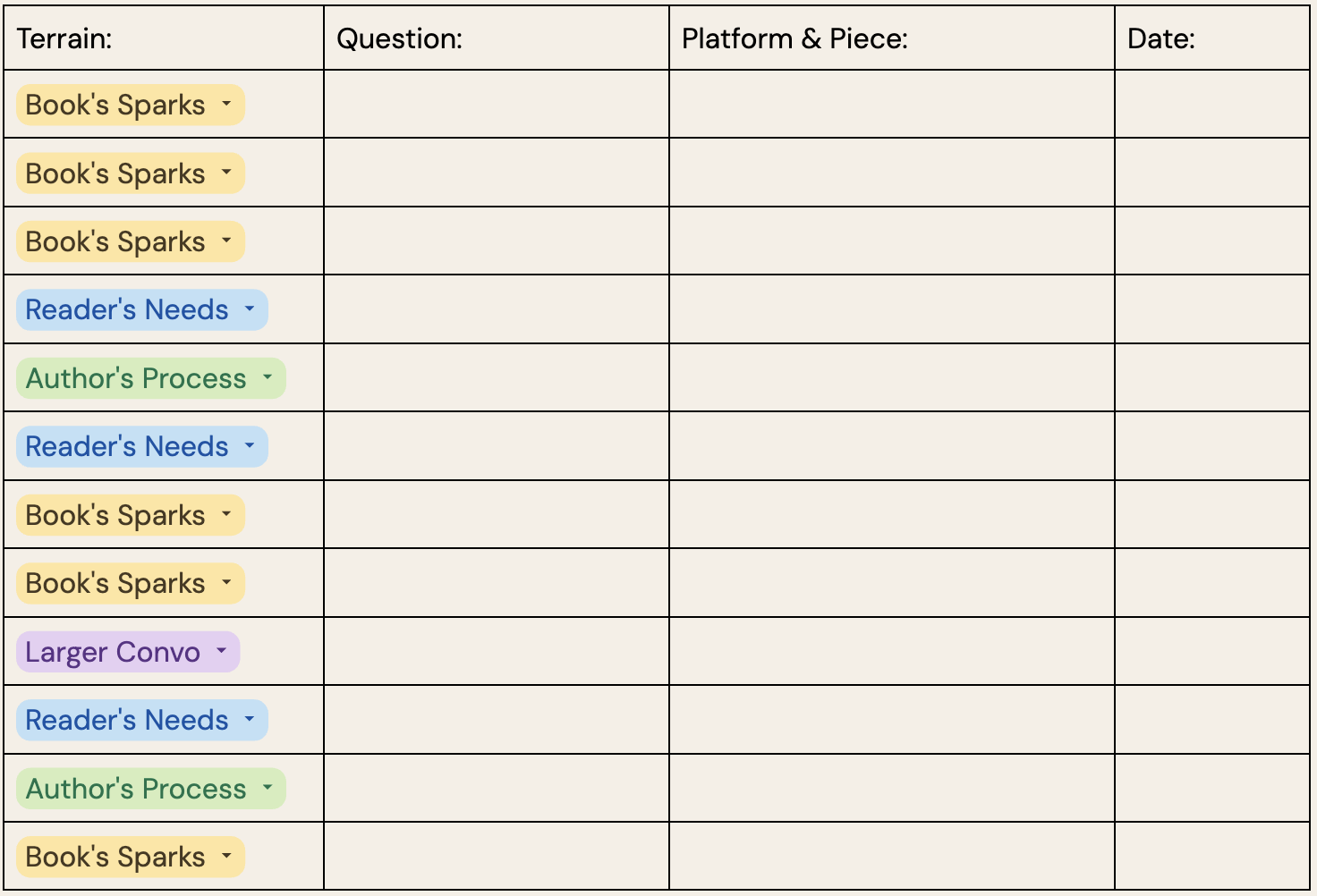
If making yourself a similar table/database, you might create a column where you can select which terrain you’ll publish your DIP piece from. Then a column to write out the exact prompt or question you’re answering. You might add a column to clarify what platform (and format) youll put the piece on—for example, “Instagram carousel.” Finally, you might want columns for the name of the piece and the date you plan to publish it on.
As you DIP in Phase 1, along with the other phases, it will be up to you to choose whether you want to create 1 piece per month, 1 piece per week, or several pieces each week.
—
Phase 2: Designing and Building the Book
Time: 3–12 months (or more)
This phase can be fun, it can be grueling, and there is a high likelihood that it will change you (in good ways) as the author. During this phase, you are actually writing the book. Some of what you write might be shared on your platform, and some of it you might hold back and only include in your book.
To draft these pieces, you of course might just be following your book’s outline. But, if you’re using the terrains to help you write your book, you will create a lot of content from the Reader’s Needs questions and Author’s Process questions (Terrains 2 and 3) during this phase. You’ll also get more into the Larger Convo questions (Terrain 4), while still going back and answering or upgrading your responses to the Book’s Sparks questions (Terrain 1) as well.
Actually, you might want to update any and every piece you published in Stage 1 (for ex: blog posts, community posts, social media pieces) to let people know your book is actually in progress, and to invite them to sign up for a notification list.
Phase 3: Launching and Selling the Book
Time: Ongoing/evergreen
In this phase your book is out there, offering something important to the larger convo or genre it’s a part of. Your book will now ideally be creating the impact and legacy you intended.
To create evergreen book marketing assets, you will mainly answer questions from Terrain 4, the Larger Convo. But (and this is a BIG thing), you’ll still be writing and maturing pieces from the first 3 terrains as well: the Book’s Sparks, the Reader’s Needs, and your Author’s Process questions.
Now that you’ve had more time to process what you previously published, and now that the book is finalized, you can close open loops. You can upgrade pieces and turn them into experiences or events related to the book. You can create supplementary book club materials. You can share intentions you had when you started the book and what happened to them over time. You can get into the bigger picture difficulties you came up against while writing, or why you made certain decisions, or how you think about things now that you didn’t realize/think before, etc.
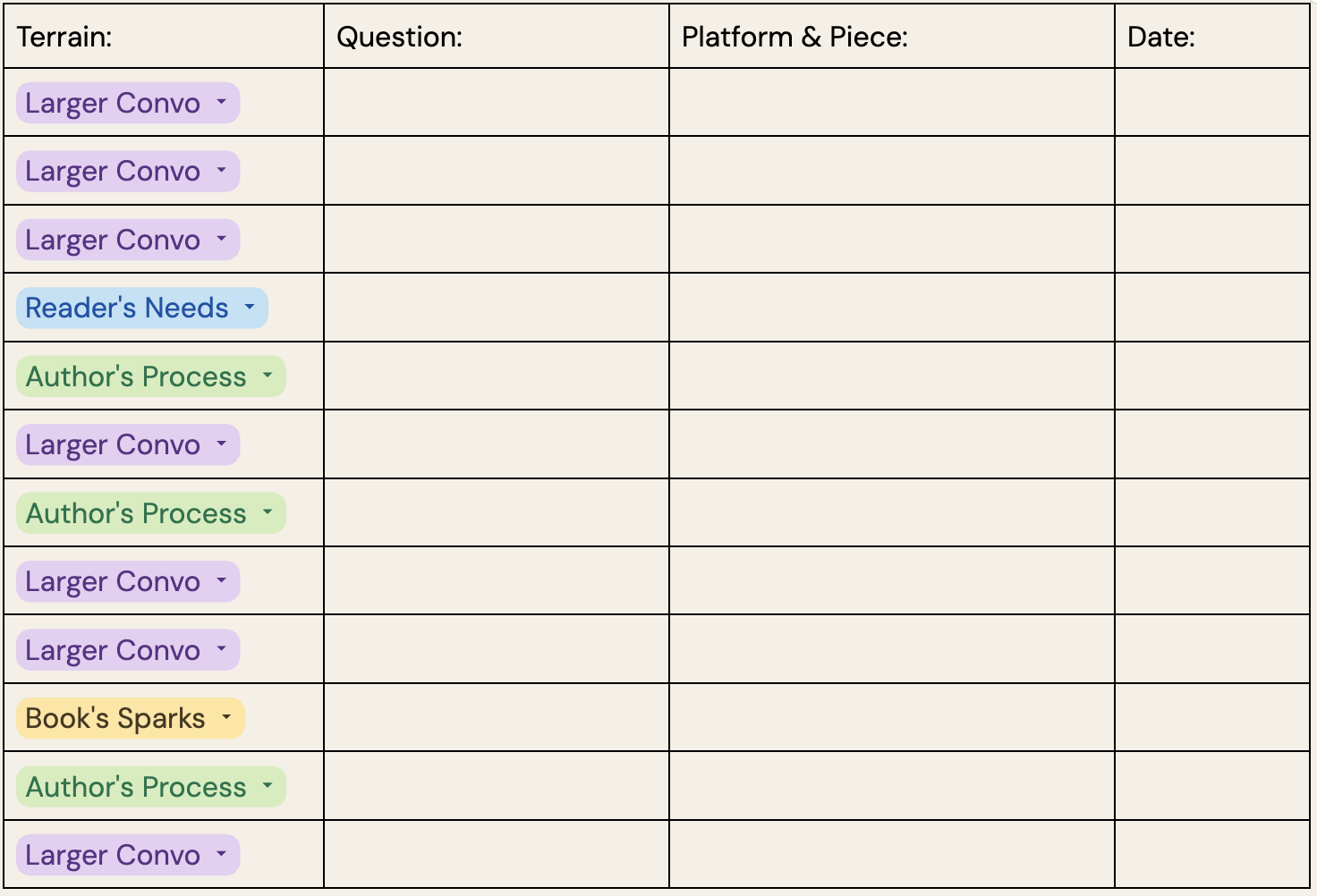
P.S. Just as with the other phases . . . in the Write Online Now Workbook I created for you, there’s a table where you can plan your DIP pieces during this phase.
Okay.
To wrap up this whole guide, here are a few helpful guidelines when DIP-ing:
As you move to new phases, go back to all the pieces you created in the previous phase(s), and wherever applicable, link the pieces to the actual published book (your “buy now” link, or if your book is not available yet, your “sign up to be the first to know when the book is out” link).
Update the description box of your YouTube videos, update your blog posts, and add a pre-roll/outro to past podcast episodes with your most up-to-date directions or calls to action.
Rethread something on Threads with the link to the book.
Move or repost from your IG grid/stories.
Etc.
Phase 3 is ongoing. It lasts for the entire shelf life of the book (as in: however long you want it to sell for). That said, you won’t necessarily be producing the same volume of pieces that you did in the first two phases. Make your publishing rhythm make sense for you as you go through different seasons.
This might mean publishing one or two pieces per month that help to sell the book.
Or, it might mean simply updating some old pieces one month.
But, it also might mean a whole season passes where you don’t publish/update anything at all, and allow your past pieces to do their work.
As you DIP in Phases 1 and 2, consider having a meeting with yourself once or twice a month to assess what you’ve written so far:
Does it need updating? Do you have a more refined take on it now?
Does it belong in the actual book?
Would it be a good fit for an evergreen marketing asset that you can turn into an ad?
Can you publish it in a different format or on a different platform from the spectrum of DIP projects to help spread its reach?
Etc. You can also ask these questions as you DIP in Phase 3 as well.
—
These are just a few notes and tips on how you might approach the stages of DIP, but you can of course choose a different path that works for you.
You may also choose to just DIP as you write your actual book (Phase 2), instead of DIP-ing to figure out your book (Phase 1) or to launch and market it (Phase 3).
Bottom line:
You are smart, you are talented, and you know how your brain works better than I do. Please, take this whole guide that I created for you and use it as a starting point or a thought exercise. Make it work for you. I trust you to figure out how to transform it into a helpful tool for your writing process.
Thank you for reading!
And if you if you ever want to report back on how you used or modified this process, please feel free to get in touch.