
Write Online Now, So Your Book Will Have Buyers and Readers Later
It’s natural to think that building a platform, writing a nonfiction book, launching your book, and keeping the book selling are all separate jobs . . . but there’s a type of powerful pre-publication writing you can employ to do all four.
In this quick guide, we’ll talk about finding the “portable insights” and “charged moments” inside the world of your book, and publishing meaningful pieces from them. Pieces that help people find you, help you write a better book, build real reader interest before you launch, and keep giving people reasons to buy, read, and recommend your book long after it’s out.

Let’s use a few fictional and real folks as examples as we chat today.
Let’s say that:
Loretta is writing a lesson-style memoir about being the primary caregiver for her parents as they age.
Reginald is writing a sci-fi novel about survival and inequity in a post-Earth reality. [Even though I deal primarily in nonfiction, let’s include a fiction example too. Why not?]
Priya is writing a book about making gatherings more meaningful. Hint: We’re rewinding and pretending this is before (the very real) Priya Parker wrote her book The Art of Gathering.
You might be able to guess my answer to the following question, but I’d love to know what you think.
Whether these authors (above 👆🏽) self-publish or “traditionally publish” their books, which of the following will they probably use writing for:
To build and maintain a platform for their book before it comes out (likely through writing online, in print mags, or “writing” in the form of podcast interviews and YouTube videos, etc.)
To create the actual book
To launch and sell their book . . . and then to keep selling it long after its release (through emails, online community posts, podcasting, YouTubing, article writing, blog writing, and more)
All of the above
👇🏽
My answer is not only that they’ll use writing for “all of the above” . . . but that “all of the above are actually the same writing” (or rather, that they’re made up of the same substance).
Meaning . . . 👇🏽
If you break down what makes a book “shelf stable” (as in: able to remain relevant and sell for years + years + years) to its smallest units, I believe you will find two things: portable insights and charged moments.
So, what are “portable insights” in the context of your book?
They are insights that you as the author are able to transfer to your reader. Usable ideas that change things, helps us make sense of our world, or even have a freeing effect on us.
So, some of Loretta’s portable insights might be:
How calling a caregiver “a saint” allows you to excuse yourself from helping them.
Or, how eldest daughters often get the primary caregiver role (for their aging parents or grandparents) by default, not through consent. The family just starts routing things through them and expecting things of them.
Or, that the grieving begins while your parents/grandparents are still with you. You can miss someone who is sitting right in front of you when their health and your caregiving role change the relationship you have with them.
Some of Priya’s portable insights might be:
Your gathering begins the moment guests learn of it, not when they physically enter the space or log on to the Zoom; this should change everything you do with the invitation, the lead-up, etc.
Good food, a good playlist, and good manners don’t magically combine together and make a great gathering worth having. You have to give your event a true purpose (specific enough to exclude certain things and people) to create meaning.
These are just examples, but you probably get the point. Portable insights help us, free us, direct us, and/or give us the tools and words we are missing as we try to process something important.
And what are “charged moments” then?
They are memorably true slices of life (stories, moments, etc.) that strike a chord or fill a need in us—your readers. A need we might not have known we had until we came across your writing and were touched, humored, or witnessed.
A lot of times when you share charged moments in your writing, your readers—perhaps for the first time ever—grant themselves permission to truly feel what they’re feeling or to acknowledge the depth of their situation. They might also feel like they can take up a little bit more space for the first time, or they might simply be delighted to discover they’re not alone in a specific type of life experience.
One of Loretta’s charged moments might be:
The story of a family New Year’s celebration one year where her brother asked her about her goals for the year, and she broke down crying . . . and eventually yelling about how she needed more help from her siblings. Maybe it was then that she realized caregiving had changed her relationship with time. She spent so long only able to live in two-hour increments (between pills, check-ins, meal prep, and other tasks), while other people were able to plan their whole year and set lofty goals.
One of the charged moments in Reggie’s book might be:
A scene where the main character, an interplanetary fixer/spy (who had to work for questionable people in order to save enough money to send her little brother off Earth 20 years ago, before it totally collapsed) tries to draw his picture from memory every year on his birthday. She’s deeply saddened because her pictures get less accurate/detailed over the years, but she can't keep any real pictures of her brother, because with her line of work, it could put him in danger.
—
Again, these are just a few examples off the top of my head (of charged moments and portable insights), but I hope they illustrate how if you were to come across something like them in a book or in an article/video/etc. online, you might have a meaningful reaction to it.
I can imagine readers of Loretta’s story feeling for her and getting mad with her at her family for not offering enough support. I can also imagine her readers quoting and sharing her insights on the dangers of calling caregivers “saints” or “angels.” It puts caregivers in a position where they feel like they can’t refuse their caregiver duties now (or ask for adequate help), and it puts the person calling them that in a position where they can excuse themselves from helping, because “oh, my sister, the absolute saint, has got it taken care of.”
Your book, and all of the articles, videos, podcast episodes, and/or essays that you write before/after it comes out, will be made up of portable insights and charged moments, just like the ones above.
I have a two-minute personal story to tell about charged moments and portable insights.
I mainly write and think in terms of nonfiction work. But, as someone who has both written a novel (a cozy mystery set in Louisiana) and someone who reads a bunch of novels, I want to take a second to point out that portable insights and charged moments can and do happen in fiction as well as nonfiction.
I can literally, viscerally remember my reaction to coming across a charged moment in the show, Private Practice, and a portable insight from the book, Detective Auntie.
I was watching an episode of Private Practice during a difficult period in life . . . I’ll say this part “out loud” because maybe someone else needs it . . . I was in an emotionally and financially abusive marriage (that was escalating toward physical abuse) with someone who was very unwell at the time.
I probably hadn’t smiled or even been able to breathe deeply in months by that point. I had no peace at home and had lost almost all ability to take care of myself.
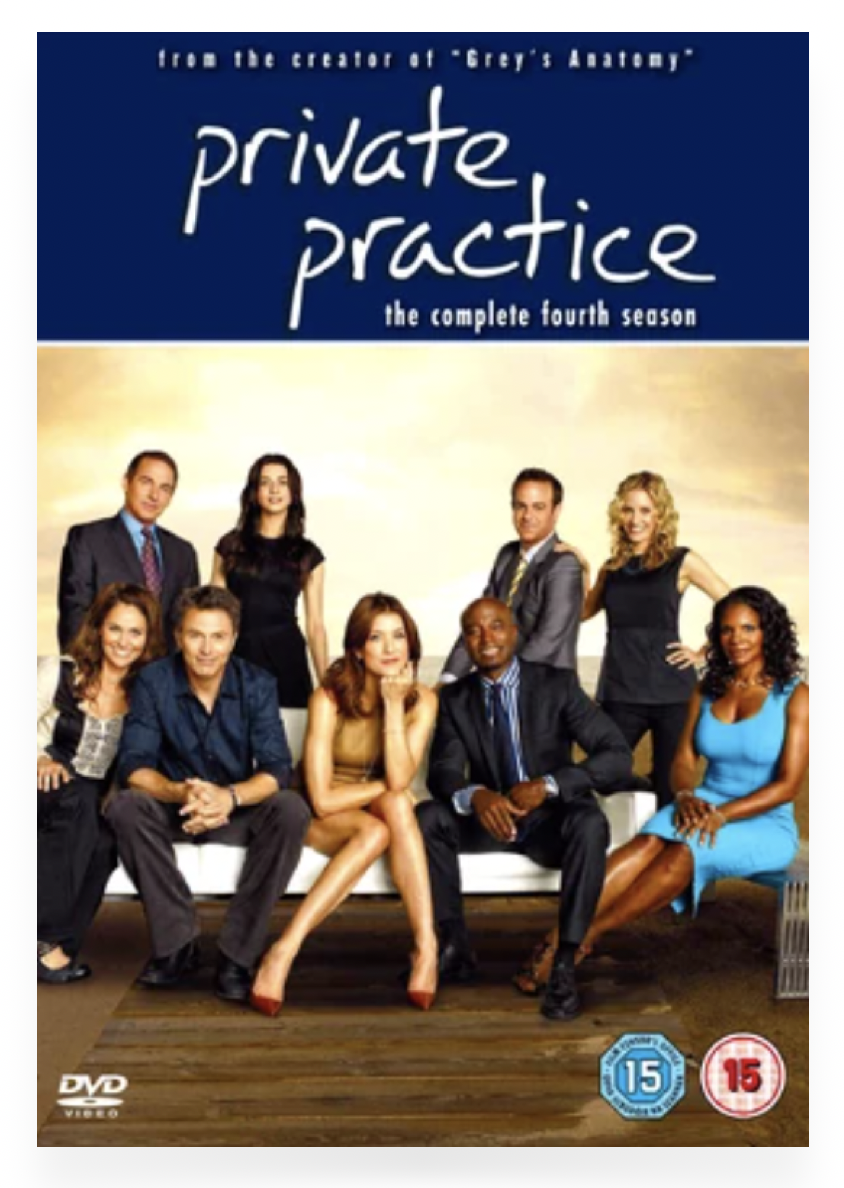
Anyhow . . . the show . . . well, one of the main characters (a brilliant woman who was desperate for love) was sitting on her couch watching a happy couple on TV. She sat there watching them with so much longing in her face. It was a well-acted scene. The thing is: I was sitting on my couch watching her, wanting her life (to be single and at my own home where I lived alone, not in danger), while she sat on her couch wanting the lives of the people on her screen. It hit me. Regina, something is wrong here. You’re in this reverse/weird inception moment, and you’d rather be single and lonely than in this relationship. It’s something I’d known, but couldn’t pinpoint (?) or accept (?) until I saw this scene. I still remember it almost 20 years later. It may seem “basic” to others, but it was this one charged moment (in fiction) that became a key piece for me to finally snap out of my traumatized state long enough to make the right decision for me.
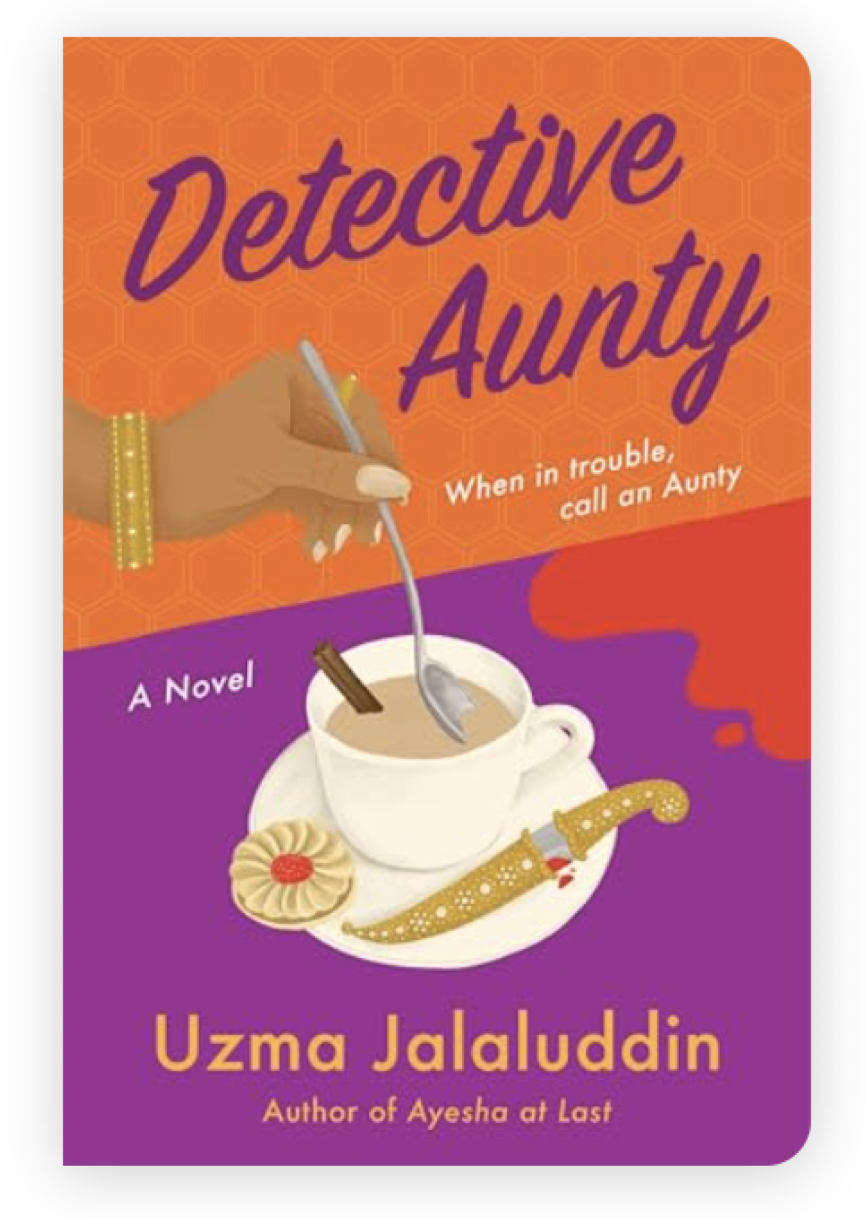
Then there was the book, Detective Aunty, which I read recently. Don’t worry, I’m not plot spoiling the mystery to tell you this.
There was a character in the book who spent time reconciling the fact that she had been married to a good man, but that that man hadn’t made a good husband.
It was danced around and addressed in a few different ways in the novel, but when it was finally worded like that (a good man doesn’t necessarily make a good husband), it helped to heal something from my past.
It was a portable insight that the author of the book stated so plainly . . . it was able to make its way to me and immediately be true, and helpful, and healing for me.
Again, even if these moments seem simple, unimportant, or even silly to others, that’s okay. They were meaningful, charged moments and portable insights to at least one person 👋🏽 (hi, it me) . . . and that’s the point. Whether you’re writing fiction, nonfiction, creative nonfiction, whatever, you can share moments and ideas that touch people, change the course of their lives, make them feel less alone, remind them to take up more space, or unlock a strategy that helps them accomplish something key.
We get to do that as authors. That’s such a blessing and an honor.
What’s your special memory of being affected by someone else’s work like this? I’m assuming if you’re reading this guide, if you’re a writer and reader, you’ve probably connected with something in a fiction or nonfiction piece so deeply that it helped to illuminate or heal something inside of you too. Was it a story or character that you found yourself in? Or an insight that the author had and then transferred over to you? What book, movie, show, or podcast did that for you?
So, in this guide, I’m going to make the case for identifying the most potent, useful, and true portable insights and charged moments (in the landscape of your book’s topics) that you have stowed away in your thinking or experiences . . . and, building your platform, your book, your launch materials, and your evergreen sales and marketing assets from them.
The question is:
If meaningful works and “shelf stable” books get the fuel for their chapters and marketing from charged moments and portable insights (hiding inside your knowledge, story, or inner world) . . . where and how do we find the best ones then publish them?
Your goal is not just to build a platform or sell your book, right? It’s to become known for the ideas inside your book. Or. It’s to spark new conversations about important things (or nuance within the current conversations) and shift your reader’s world in significant ways.
The best time to form those ideas, and begin to spark those new conversations, is not just when you’re writing your book, but before it. And after it.
Let’s do 2 things:
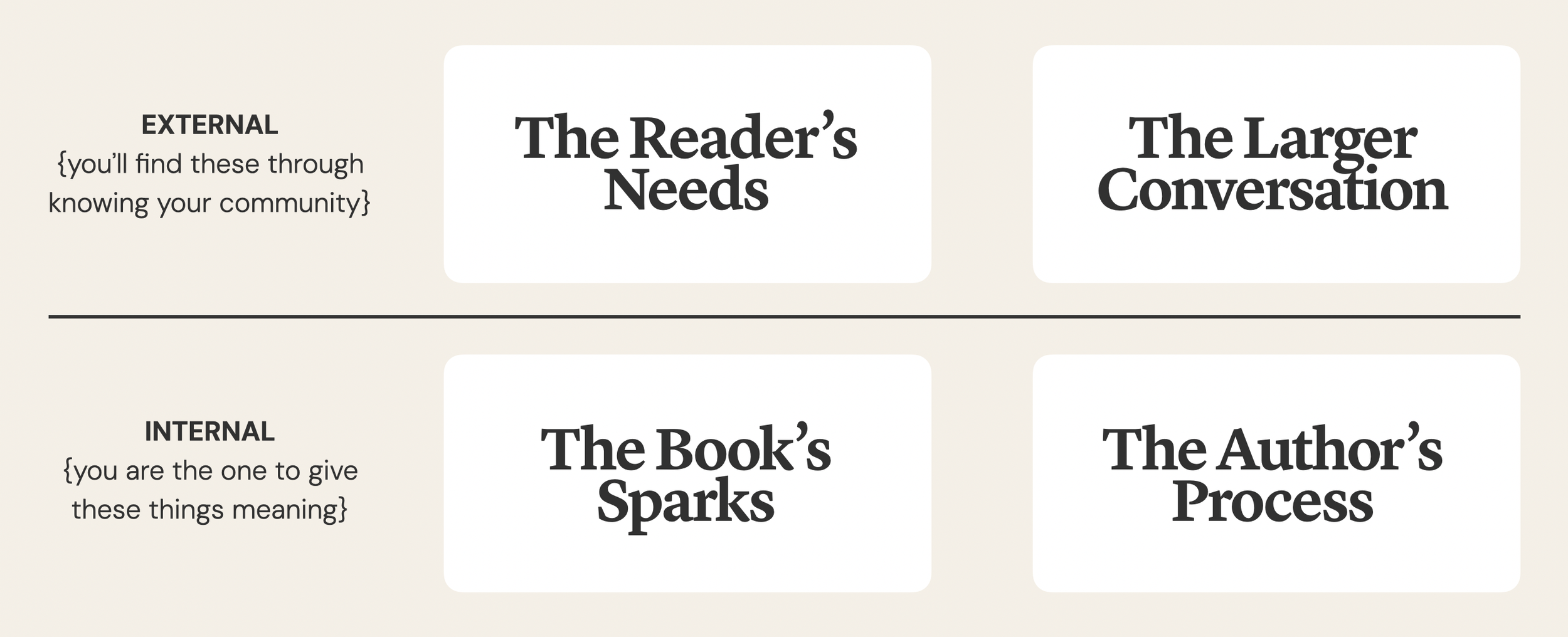
To make it more manageable and simple to arrive at your best ideas, let’s explore four terrains that make up the landscape of your book. [Again, we’ll explore these in this guide, below.]
Then, to help you share those ideas, let’s create a publishing project for you to help you build your platform and book . . . a “Draft in Public” (DIP) Project. [I’ll introduce this below, and link you to a Part 2 of this guide to explore this more fully.]
The Four Terrains That Make Up the Landscape of Your Book
Within these terrains (the Book’s Sparks, the Reader’s Needs, the Author’s Process, and the Larger Conversation) you can ask and answer guided questions to help you come up with articles, videos, key scenes, and/or chapters of your book.
↓
Terrain 1: The Book’s Sparks
KEY QUESTION: WHAT IS DRIVING THE BOOK?
These are the things that lit the fire 🔥 in you for this book, and that keep it burning while you write. The book’s sparks start out private and specific to you, but the best ones transfer and catch in other people as you explore them through writing.
I like to break down prompts and questions in this terrain into the following 5 sub-categories:
Unresolved Needs and Questions (that you may have)
Curiosities and Threads (that you can’t help but follow)
Things That Bother You (and you can’t seem to let them go)
Experiences You’ve Gathered (that are memorable or meaningful)
Unpaid Debts to Self or Others (ones that secretly/openly pull at you)
—
Let me give you some example questions under this terrain to help you imagine how they can become pieces that fill your book, build your platform, and more. Note: If you’re writing fiction, you can definitely answer these questions as yourself, but you will find that it’s a powerful experience to answer the questions as one or more of your main characters.
—
One → Unresolved Needs and Questions
Under this sub-category, you might answer questions such as:
What are the memories from your life, or from a particular project or goal, that always seem to crop back up late at night or early in the morning because something was left unsaid, undone, or unsolved? What is the scene or thing you keep replaying?
Is there a wound that you struggle to process, or that you know won’t heal until you explore it in writing?
Etc.
Let’s visit with our friendly characters from earlier to see how these might play out.

As Loretta begins to think about writing her caregiving memoir, she might ponder the second question above and realize she has a wound that stems from how her family keeps calling her “a saint” for the caregiving she’s doing. She gets increasingly angry when she hears it because it seems to excuse them from helping her. They give her praise instead of relieving her of her duties, and now she feels her needs are unspeakable.
Loretta might decide to write a short essay on LinkedIn about the disservice you do to caregivers when you praise them for their selflessness and excuse yourself from paying attention to their needs.

For Reggie’s novel, he might ponder the first question above from his protagonist’s point of view. Maybe he imagines a scene where she’s remembering standing at a launch gate, saying goodbye to her 7-yo brother. She stole, scrimped, saved, and worked for unsavory people to afford his passage off Earth before it (became completely unlivable). Maybe she worries about what she left unsaid because she struggles to remember what she said to him at all. And maybe that deeply saddens her, because in contrast, she has vivid memories of every single dangerous job she did in order to earn the money for his passage.
Reggie might decide to work this contradiction/frustration into the storyline in a few key places as incomplete flashbacks, and might close this loop in a satisfying way when the main character finally finds her brother (note: she’s been searching for him for years), and the brother remembers every sweet word she said to him that day, verbatim.
—
Two → Curiosities and Threads
Under this sub-category,you might answer questions such as:
What are some hypotheses you are testing—whether in your life, relationships, work, body, mind, goals, or your moral compass and values, etc.? What do your actions and private thought life reveal that you are trying to understand about yourself or the world?
What different, better, more interesting world do you want to live inside?
What’s the world you imagine when you think about being exactly where you’d want to be and doing exactly what you’d want to do . . . all day, every day?
Etc.
Again, let’s see what the homies have to say about this.

Just speculating here. I don’t actually know Priya in real life. But . . .
Let’s imagine that as Priya worked and consulted on events and gatherings, she began to test the hypothesis (per Question 1 above) that what actually determines how successful a gathering is (or isn’t) is your specificity of purpose in holding the event . . . not just following the generic hospitality rules that are often touted as “the way.”
She might test this in the rooms that she personally runs, and she might have clients testing this hypothesis, until she’s gathered experiences that she can transform into portable insights . . . which she might first publish as Instagram carousels or reels, before writing an essay on them for her newsletter.
Reggie might read Question 2 above and answer for one of his main characters. He might imagine that his protagonist longs to find a planetary system somewhere, where she can live under the rays of a sun like Earth’s sun. Maybe she misses the golden warmth of it, and finds other solar systems inferior.
Reggie might decide to start his story with his protagonist in a dream state, lounging on a beach somewhere and soaking up the sun. Then he might have her wake up and walk outside to a planet blanketed in red light with a smoggy atmosphere. Maybe later in the story she buys overpriced window shades (for her shipping container home) that make it look like it’s a sunny Earth day outside. Etc. He can work her longing into the story a few times and close the loop in some meaningful way. You get the point.
—
Three → Things That Bother You
Here are some questions that fit under this sub-category:
What is the big freaking lie that everyone seems to accept, that seems so obviously untrue to you?
What fits into the category of “Let’s just do it the way things have always been done.” that you don’t feel belongs there? What system or philosophy needs a major overhaul?
What is offensive to you? What makes you angry or indignant about others, yourself, or society?
Etc.
Let me give you some examples of potential answers to these questions, and how they could be turned into pieces of your platform or book.
Let’s imagine that in answer to Question 2 above, Priya might want people to stop opening every meeting or gathering by covering logistics and housekeeping notes. She might wonder: “Why spend the most powerful moment you have together on parking instructions or a schedule of events that could be communicated another way?”
Priya could create a quick LinkedIn essay or an Instagram reel/carousel about this. It could also become a point in one of her chapters.
Maybe as Loretta reads over Question 3 above, she immediately realizes that her answer is her brother who calls once a week and asks, “How’s Dad?” and seems to consider that participation in their father’s care. She might realize it’s also the people who remind her to “take a break and take care of herself,” when the caregiving she’s doing is unfortunately a round-the-clock duty, and no one offers to sub in.
Loretta might decide to open her book describing one of her brother’s weekly check-in calls, and how she hung up and afterward and shouted profanities for three minutes. Then she might get into the larger issue: being unsupported during the hardest time in her life.
As Reggie ponders Question 1 as the protagonist of his story, he might answer that she hates that the Five Families have spun the evacuation of Earth as a “rescue,” when it’s obvious to her it was more of a “sorting” of the people they wanted around vs. the ones that made them uncomfortable . . . the ones they didn’t want to share space with in the new world.
Reggie might weave this into his story as a monologue that the protagonist delivers. Or maybe it surfaces as an argument between the main character and a supporting character who worships the Five Families, oblivious to their dark motives.
—
Four → Experiences You’ve Gathered
Under this sub-category, try answering questions such as:
What are some of your favorite stories to tell new people who come into your life? Why do you want them to know those things about you?
What have you figured out (about your craft, a system, your community, or a way of living) that seems obvious to you but keeps surprising other people? What do people come to you for?
What are the most precious memories you always want to hold on to? What does each one tell you about what you value most?
Etc.
Maybe Loretta has a beautiful memory as she ponders Question 3 above:
Her memory might be of her father teaching her to drive a manual transmission truck in a church parking lot. Both of them could not stop laughing at the amount of times she stalled the car. Even though it’s a different vehicle, she drives her dad to his appointments in a stick shift SUV, and it still makes them laugh sometimes.
Loretta might weave this story into an essay on how your relationship with your parents changes significantly when you become their caregiver (and how any little remnants of the old relationship can be special blessings/moments) that she publishes on Substack. It may eventually get woven into a chapter of her book too.
—
Five → Unpaid Debts to Self and Others
Under this sub-category, you might answer questions such as:
Who or what needs to be witnessed more fully? What situations or communities get swept under the rug that you feel you must fight for or expose? Whose story goes untold far too often?
Is there something you did or failed to do that you’re still reckoning with? That you still feel you owe a debt for?
What’s happening inside/around you or to a specific community that makes this book timely or necessary right now?
Etc.
Maybe Priya (and again, I don’t know her personally so I’m just speculating) was working on The Art of Gathering and:
Perhaps Priya felt that across politics, faith, and family, people have lost the ability to sit across from someone they disagree with and create community with them, or hold helpful discussions with them . . . and maybe she felt that this ability will be more and more important in the coming years. So, as she pondered Question 3 above, Some of her resolve to publish this book now might have set in.
Perhaps Priya could then write a mini-essay (on her site and social media) on why she’s writing the book now and the new way in which we need to be thinking about community/gatherings going forward.
Before we continue on to Terrain 2, I should mention: I made you a companion workbook to go along with this guide.
It has 120+ questions across the 4 terrains, along with a section to help you choose a “Draft in Public” (DIP) Project for your book.
P.S. I explain DIPs in this article on my site—which is Part 2 of this guide.
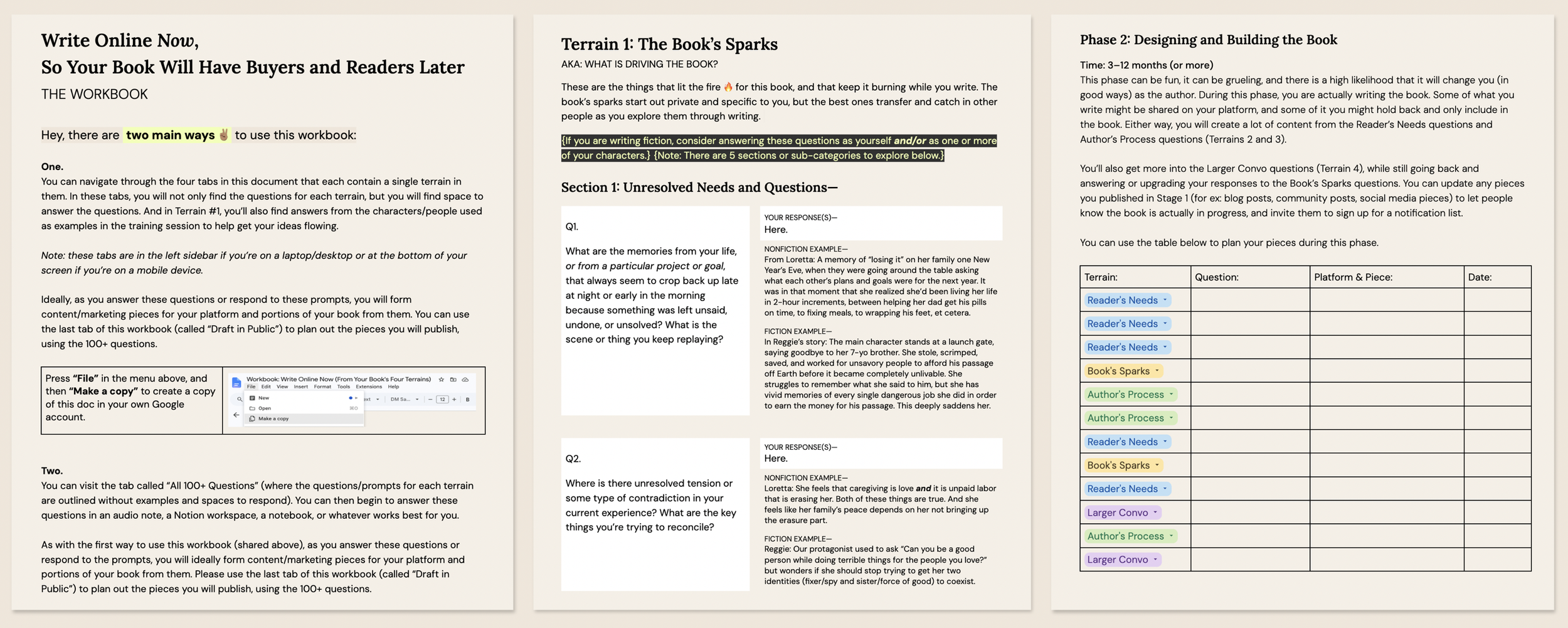
I’ll tell you how to sign up for the workbook in a sec (below). But, if you wanna skip the line, you can get to it here, and then follow along with the rest of this guide after downloading the companion workbook—made for you in Google Docs.
For now, let’s keep going to the second terrain.
↓
Terrain 2: The Reader’s Needs
KEY QUESTION: WHAT STATE ARE THEY IN BEFORE ENGAGING WITH YOUR BOOK?
This includes the friction, hopes, longings, and pieces of their identity and beliefs that direct their way of being in the world. You don’t create these needs—they often exist long before your readers come across your book. You are here to recognize the needs, deeply. Which means a stranger can read your work and think “Wait. This is (for) me.”
I like to break down prompts and questions in this terrain into the following 5 sub-categories:
Motion and Friction (they’re experiencing)
Emotional State (that they’re in)
Identity and Beliefs (they’re operating under)
Relationships and Self-Advocacy (that they have—or wish they had)
Hopes, Goals, and Longings (that likely direct their actions)
—
Let me give you some example questions under this terrain to help you imagine how they can become pieces that fill your book, build your platform, and more. Note: If you’re writing fiction, you can definitely answer these questions for your readers, but you will find that it’s a powerful exercise to answer these questions for the people or communities surrounding your main characters and/or, if applicable, these can also be answered for your main characters.
—
Motion and Friction →
Why did a standard prescription, solution, or playbook they tried not fit their life or situation? What keeps not working even though they’re trying? What systems or advice have failed them in an area they’d like traction or progress?
Are they trying to work within a structure that isn’t built for them? Do they not have enough support, context, resources for success in a certain area?
Etc.
Emotional State →
What people or situations have them hiding out, stressing, or bracing for the worst?
What has become normal to them that shouldn’t be? What are they managing daily that they shouldn’t have to?
What do they feel guilty about that isn’t actually their fault?
Etc.
Identity and Beliefs →
Who do they feel they’re not allowed to be? Are they proud, fond, or scared of who they used to be? Who do they fear they’re becoming?
What assumptions, worldviews, or beliefs have they inherited from their family, culture, religion, workplace, or friends that are getting in the way of who they want to become? Which inherited assumptions, internalized myths, or beliefs are helping them?
Etc.
Relationships and Self-Advocacy →
What expectations do others place on them? What do they place on themselves? Who are they most afraid to disappoint?
What do they feel they deserve? What do they feel they’re undeserving of?
Etc.
Hopes, Goals, and Longings →
What’s the life they imagine for themselves? Are they mourning the life they thought they’d have? What areas have turned out better than expected?
What do they long for that they don’t have language for yet?
What’s the thing they might not admit they want? The thing they feel guilty or unrealistic about hoping for?
Etc.
—
Can you imagine how a few of the questions above can spark a scene or moment in your fiction writing . . . or a story or lesson for your nonfiction book (and the platform you’re building to engage more readers)?
Now, let’s go over Terrains 3 and 4, then talk about Part 2 of this guide—on designing a Draft in Public Project to help you build your platform, book, and marketing materials.
↓
Terrain 3: The Author’s Process
KEY QUESTION: HOW DO YOU ARRIVE AT THE BOOK AND WORK THROUGH IT?
This terrain is about what you discover, wrestle with (what you cut, what’s hard to write, etc.), and overcome to write your book. It’s also your relationship to the craft of writing, and at times . . . your openness to co-creating with the people you are writing for.
This terrain is not about writing the “still writing, send coffee!” style of updates. These are pieces you’ll create to truly share what you’re processing . . . and they’ll be a primary way that readers come to trust you and get invested in the journey with you.
Let’s break down the prompts and questions in this terrain into the following sub-categories:
Decisions (you’re processing through)
Surprises and Discoveries (you come across)
Difficulties (that come up as you work)
Relationship to the Craft (that you have or are trying to create)
Invitations to Readers (that you want to make)
Below are some example questions and prompts in this terrain.
—
Decisions →
What’s a decision you made about your book/material that most people in your genre wouldn’t have made? What drew you toward this other path?
At any point, did you realize you were trying to make the book fit into a specific structure that you had to let go? Why did you change the structure? Was there something you needed the reader to feel, realize, or comprehend that you couldn’t accomplish with the original structure?
Etc.
Surprises and Discoveries →
What did you believe about your subject, your story, or one of your characters when you started writing this book that you no longer believe? Is there an old philosophy, worldview, or way of thinking you used to have that your writing has helped to highlight and break down?
Is there something that you wrote into your story—or your advice for readers—that you later realized you needed to practice, accept, or understand on a deeper level yourself?
What are you surprised to find that writing this book is actually healing inside you as the author? Are you grieving, releasing, or even outgrowing things in real time as the book takes shape?
Etc.
Difficulties →
[For when you’re in a writing dip] Who does this book require you to be in order to finish it? Why is it hard to get there and be that person? What does this mean for what you need to change?
How do you write about a wound without reopening it or harming yourself in the process?
Was there a character, a framework, or a specific chapter that seemed to resist what you were trying to make it into? Why was it happening? How did you resolve it?
Etc.
Relationship to the Craft →
What tools, systems, or constraints do you rely on to help you finish your writing? What conditions are non-negotiable for you?
Is there an additional book or a different type of book (for example: a memoir, a handbook, a work of fiction, a manifesto, an academic paper, a workbook, etc.) hiding inside your current manuscript?
Etc.
Invitations to Readers →
Is there a part of your work (or a complementary resource to go along with your book) that you could build with your readers rather than for them? Perhaps it could be a glossary, a collection of reader stories or insights, case studies within the book, etc.
Which ideas or story snippets from your book can you test with people as you write them? What benefit might you or your readers experience if you decide to teach or share stories from your work before they’re finalized (instead of writing the whole manuscript privately)?
Etc.
—
This is a lot, huh? Well . . . good news. We only have one more terrain to cover. But again, please feel free to signup and download the workbook for this guide here.
↓
Terrain 4: The Larger Conversation
KEY QUESTION: HOW DOES YOUR BOOK FIT INTO THE LARGER STORY?
These are the conversations your book starts, joins, and/or shapes. It’s the language it gives people for things they already felt (but couldn’t express) or the things they needed articulated a certain way to understand. This is when your book is no longer just your precious project, but something people can use, journey through, argue with, quote, gift to a friend, and make changes from.
Let’s break down the prompts and questions in this terrain into the following sub-categories:
Conversations It Starts
Conversations It Joins or Narratives It Challenges
Labels, Systems, and Models It Gives (to society, to others you care about)
Hidden Things It Reveals
Changes It Makes Possible (in the world, in various communities, in readers)
Below are some example questions and prompts in this terrain.
—
Conversations It Starts →
What are people able to say to their bosses, partners, or parents for the first time after reading this book? Is there a shift in dialogue that’s able to take place?
What do you feel remains unsaid, underexplored, oversimplified, or misunderstood in your topic or genre? How does your book introduce or highlight these things?
[If writing fiction] What are the main themes and understandings that will remain with your readers even after they’ve forgotten many of your plot points?
Etc.
Conversations It Joins or Narratives It Challenges →
What are the primary schools of thought or works that exist in your topic or genre? What is this book challenging or doing that those other works don’t?
What myths or assumptions did you work hard to not operate from in order to write the best book you could?
Does your book contain a character or community that is constrained by an expectation of who they’re supposed to be? In what ways does that character/community accept that role or story? How does that character/community reject or rewrite the story?
And more.
Labels, Systems, and Models It Gives →
What is the language, system, or problem-solving approach you give readers inside your book that empowers them to make healthier decisions for themselves?
What terms are currently being used to describe your subject/community? How do these terms minimize or distort things, and what terms are you offering in their place?
Etc.
Hidden Things It Reveals →
What parts of a certain community’s reality do people inside the community know, but outsiders often miss? What realities are so inconvenient, ordinary, or difficult to measure/explain, that they’ve previously gone undocumented? How does your book share these things?
Who has been laboring or suffering under a current system, societal norm, or government structure? What does your book surface or bring to light about these people?
[If writing fiction] What injustice or inequity will your reader likely come to understand before one or more of the characters themselves acknowledge it?
Does your book help people realize that they’ve been obeying “rules” that were created by someone with less-than-noble motives?
Etc.
Changes It Makes Possible →
[If writing fiction] What will your readers have a harder time tolerating or dismissing in their own lives after they’ve lived inside the world of your story?
What might a person feel less ashamed of after reading your book?
What are you giving people permission to want or pursue that they often get discouraged or punished for pursuing?
[If writing fiction] When and where do you highlight the difference between a character who claims permission for something and another character who cannot grant themselves that same permission?
What shifts in identity, priorities, perspective, or state need to happen before your book’s philosophies, advice, or takeaways will actually work for your reader?
Etc.
—
I believe that the more of these terrain questions you deeply ponder and attempt to answer (especially in public pieces that you share), the better you get at creating extremely useful and moving work, in your book and beyond.
And the great thing is that if you’re working on a book that you want to be a perennial seller, there’s really no downside in answering these questions. ↓
At the very least, they can help you write sections of your book faster. But realistically, if you publish them in public places, they can help you get the feedback you need to make an even better book, help you build an engaged reader base before your book comes out, and help you arrive at the most distinct and honest way to tell your stories and/or teach the lessons you want to teach.
Now, how do you really turn these terrains and prompts into pieces that help build your platform and book?
Instead of simply answering one question per week and trying to piece together your book and platform like that, I recommend choosing a “Draft in Public” (DIP) Project to help you build your platform, book, and marketing materials.
In the article linked below (which is Part 2 of this Write Online Now Guide) I’ll go over what DIPs are, the spectrum of projects you can choose for yourself, how to know what to write, and how to break your writing down into 3 helpful phases, so you’ll have milestones or checkpoints as you go.
Check out Part 2, a.k.a. “Design a Draft in Public (DIP) Project to Build Your Book and Platform at the Same Time” right here.
P.S. I hope you find the Four Terrains useful as you write your first/next book, and if you if you ever want to report back on how you used or modified this process, please feel free to get in touch.