
Pick Your Next Publishing Project to Match Your Current Stage of Thought Leadership
Think of this guide as a “decision tree” for figuring out what to publish next (and why), no matter where you are in the process of growing your platform as a changemaker or thought leader.
Whether you’ve been at it for a week or over a decade, there is a publishing project that can meet you where you’re at and help you extend the reach of your ideas.
→
Before we get deep into it, I want to start by saying that the following ideas are not theoretical. They come from the thousands of hours I've spent, since 2014, consulting with people who believe in the meaningful work they're doing. But, the ideas mostly come from my most recent 1,500 hours spent strategizing with big idea people:
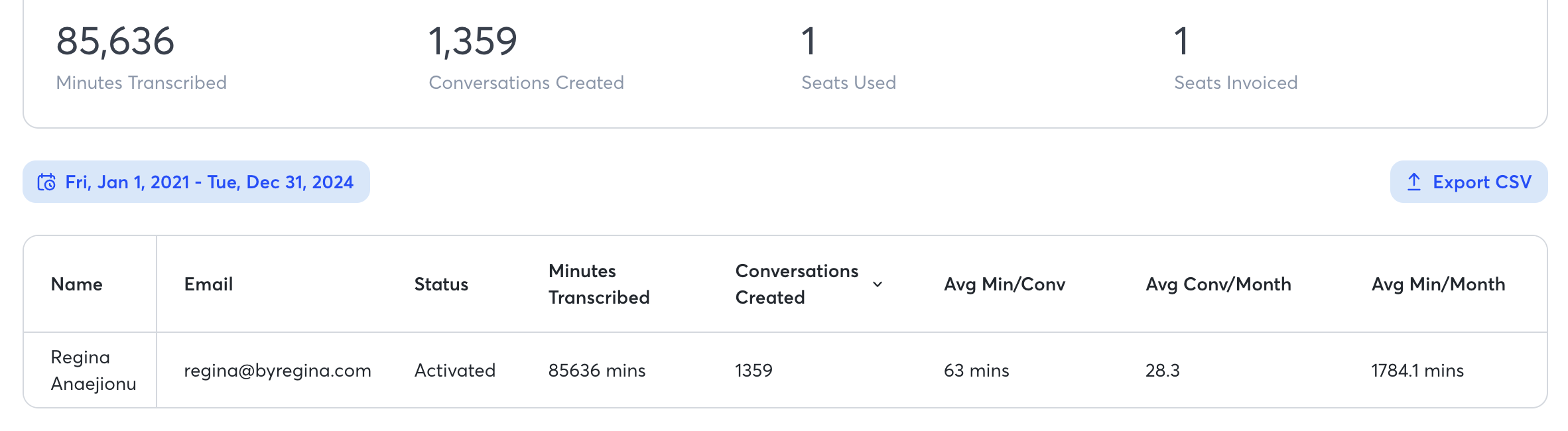
For context, I released a new program in 2021 that guides changemakers through creating an "operating system" to help them establish and grow their online platform . . . and for the four years after I created that program, I hosted a lot of 1-on-1 sessions. In fact, from 2021–2024, I spent 1,427 hours on client calls and group workshops (as in: about 30 calls & ~30 hours per month).
I share this so you know where and why what I’m offering you below is coming from.
As you can likely imagine, during the last few years of strategy sessions with clients, I helped people plan a wide variety of publishing projects . . . because what works for one person (who for example, has published multiple books and 100s of successful essays or articles), likely won’t work for another person (who might know the direction they want to take their topic and work, but who hasn’t hit “publish” on any pieces yet).
I want this guide to offer a more nuanced take on what you might want to publish next, and why. Generic content prescriptions ("Post 3x/day on social media!" or "Just make 1 yap video per day!") can be harmful to thoughtful changemakers whose work runs on depth and critical thinking.
P.S. Not once in all these years with thought leaders was my advice ❌ "Publish 2–5 times per day on social media." In fact, some of my clients don't even use social media.
What we're talking about today (and always) is publishing projects that help you establish a meaningful, evergreen body of work that can compound in value to you and others.
TL;DR on my little rant above → Your ideas, your work, you . . . deserve more nuance than one-size-fits-all publishing advice.
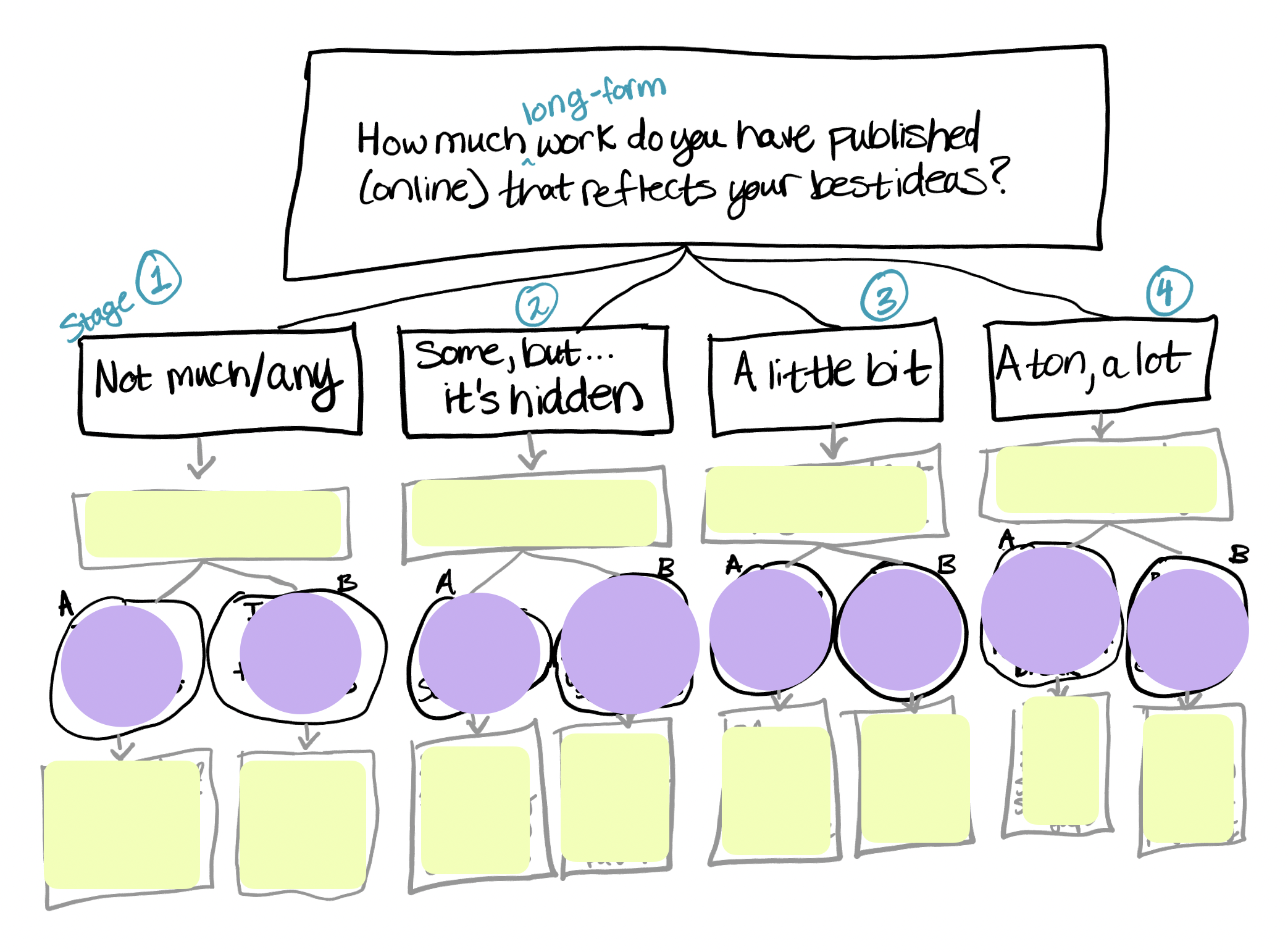
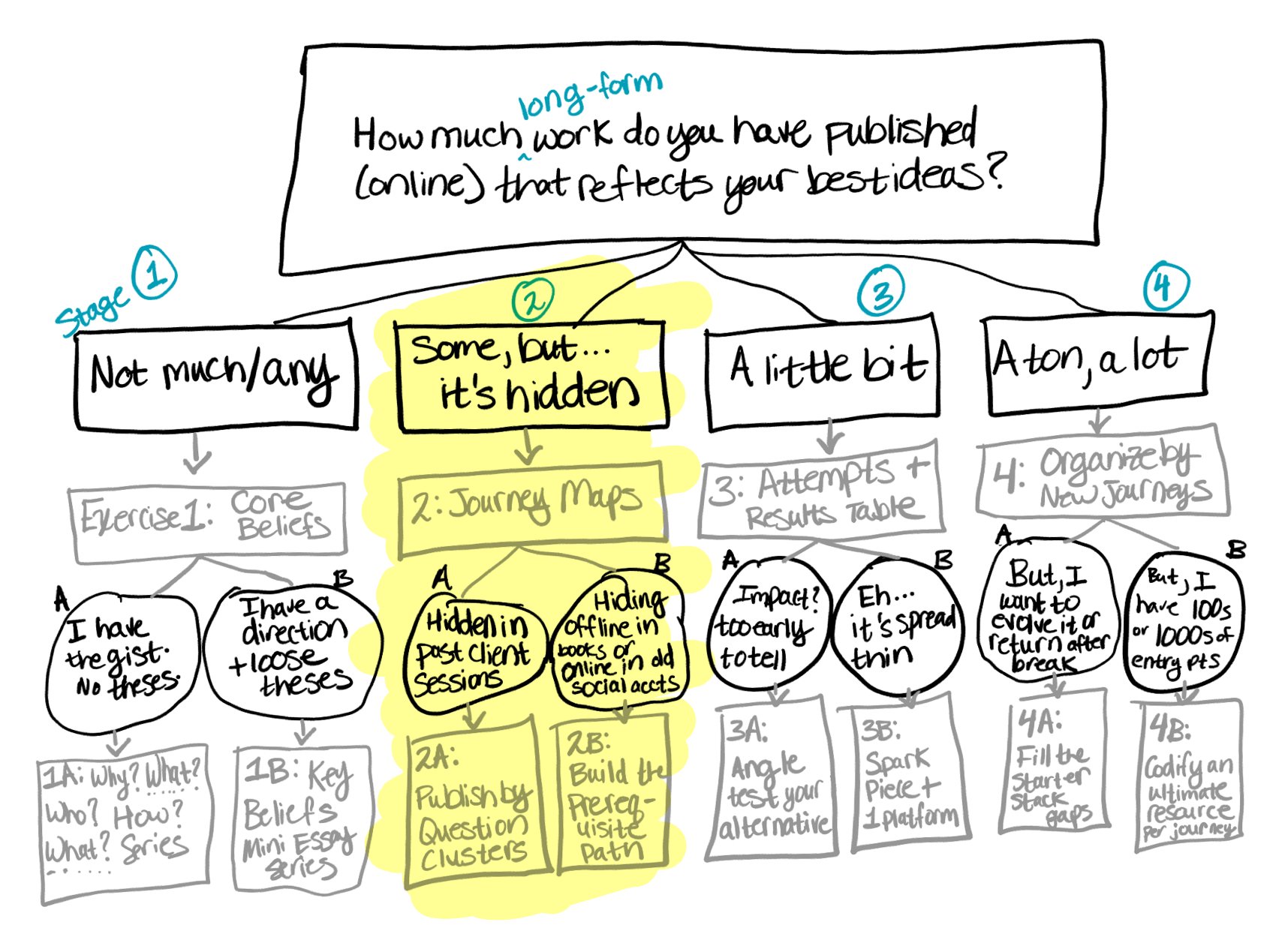
Our goal for today is to think and talk through the 4 main stages you might be in (which each branch off in 2 directions), the pump-fake publishing projects that might try to tempt you (a.k.a. ones that seem good but probably aren’t right for you), and the ideas or projects that are likely to be a solid fit for your goals.
The 4 Main Stages You Might Be In While Building or Growing Your Thought Leadership Platform Online
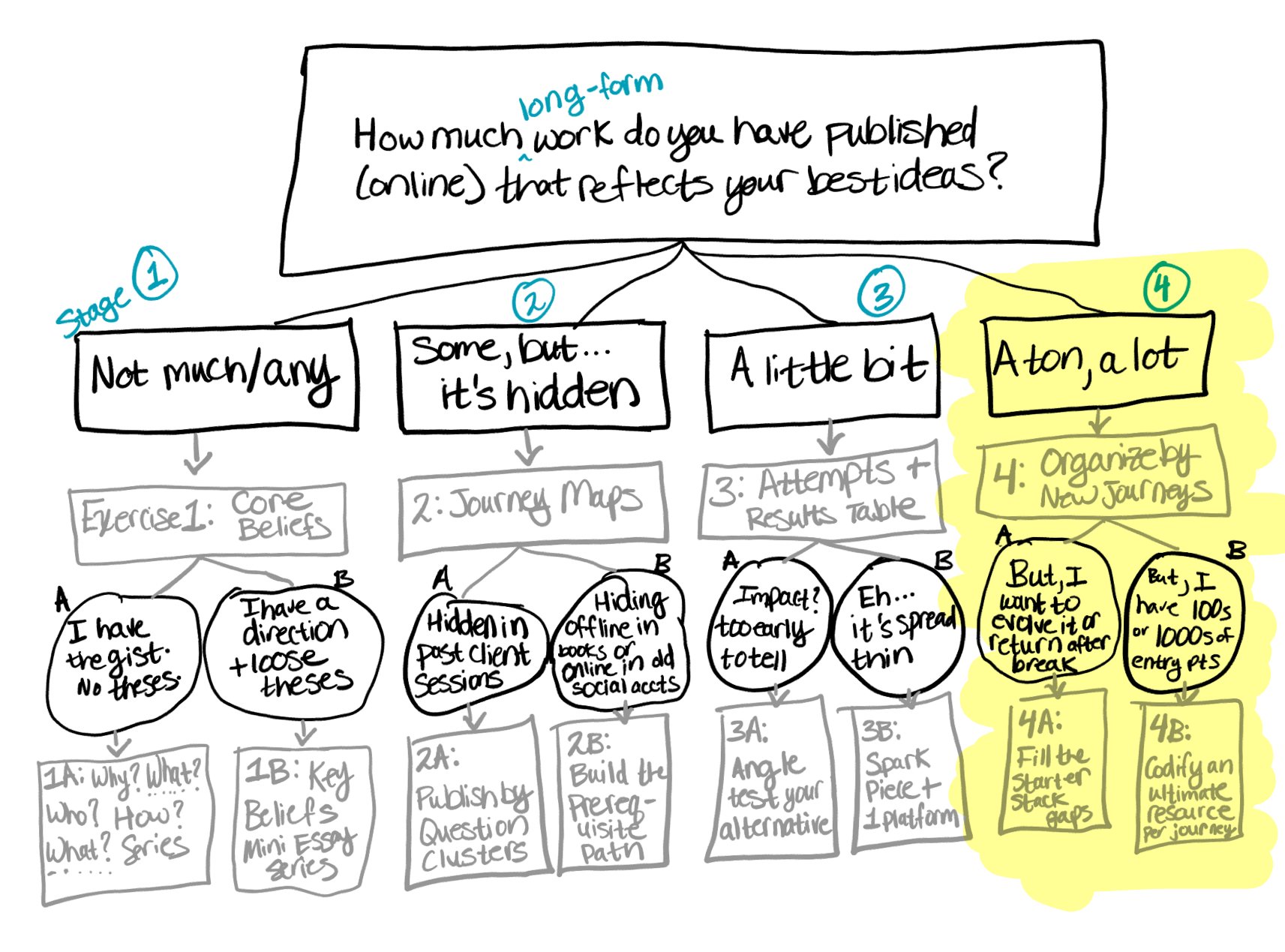
First, let me introduce you to the four big “branches” of our decision tree. They’re simple because they’re organized by how much of a body of (evergreen and published) work you have online:
Nothing (much) published
A hidden body of work
A little published work
Tons of published pieces
Hint: We’ll get into some branches/segmentation below, because there might be multiple different reasons you have a "hidden" body of work, for example, and the publishing projects you'll choose to pursue next will depend on why and how you find yourself in that position.
Directly below is a quick description of the four main stages, so you know which part of this guide to jump to. (As in: You can read the guide in order if you want to, but you can also just head to the section most relevant to you. The full guide is hefty and not for the faint of heart, so I've provided navigation links to each stage below.)
—
You’re at “Stage 1: Not Much Published” if →
Even though you want to publish important things online, you haven't yet built a publishing habit, so you don't currently have a platform where you're known for your specific topic.
This might be because you just recently gave yourself permission to build a body of thought and work around a topic you care about. Or, maybe you only now have the time to build something new. Or, perhaps there's a topic you've always been deeply interested in but you never could quite figure out how to approach publishing about it online.
Some people are even understandably afraid to start publishing about new topics while connected online to certain family members, past coworkers, friends, or current colleagues. “What might they think? Will they laugh? Do I even have a right to publish about this?”
You might also be someone who has published a whole lot online, but you haven't published much, if anything, about this specific topic that's calling to you now.
If you find yourself in any of the states above, head to Stage 1 (in the main section below) for some publishing project ideas that might be a good fit for you.
—
You’re at “Stage 2: Hidden Body of Work” if →
You’ve published a fair amount of work around your current topic, but it’s mainly been in formats or places you no longer have access to.
This might mean your best ideas came out in the form of client conversations, consulting arrangements, or even workshops or talks you've given.
Or, your ideas might have mainly been shared in a past role at a company where you mentored, published internally at work, etc.
Or, your ideas might exist primarily on an old blog, publication you freelanced for, or even a social media account you no longer use (or even remember the password for).
So even though you've been thinking, talking, or writing about your topic for a really long time with a high level of expertise, you don't currently have an online platform where you're known for your specific topic.
If you find yourself in any of the states above, head to the "Stage 2" section below.
—
You’re at “Stage 3: A Little Published Work” if →
You’ve been publishing on a meaningful topic for a while, but you don’t feel like your platform is as strong, settled, or powerful as it can be. And you wouldn‘t necessarily classify the number of successful, long-form, evergreen pieces you’ve created (on platforms like your website, podcast, or YouTube) as “tons” or “lots and lots.”
Basically, your ideas don't have the reach that you want them to have yet. You may be at this stage because the pieces you've created simply don't have enough traction yet—maybe because of the length of time they've been around, or maybe because you don't feel you were able to make them as strong as you really wanted to, etc.
You might also find yourself in this place because you've unintentionally become a little bit of a platform and format dabbler. As in, you might publish for a little while on LinkedIn, and then you might publish a few articles on Substack, then you switch to Substack lives, then you mainly publish on Instagram stories, then Instagram reels and TikTok . . . then you write a few guest articles, then you host a workshop, then you make a few YouTube videos, etc.
Have no fear. If you find yourself in any of the states above, head to section three below for some ideas that will apply directly to you.
—
You’re at “Stage 4: Tons of Published Pieces” if →
You’ve been publishing on a meaningful topic for a long time, and have built a significant platform for your ideas. You’ve become a key thought leader and publisher in your field.
But, you might feel that your body of work is a little bit disorganized, or that you could stand to codify more things and shore up the legacy of your work.
In a sense, even though you have a strong body of work and distinct models, philosophies, and frameworks in your industry, you might still feel like the work is unfinished.
You might be in this place because your thinking on your topic has evolved, and you now feel the desire to go back and update, amend, or add to a lot of your old work. You want to mature and polish what you have so it will feel complete or more accurate. You may have even been hiding from, or embarrassed of, the state of your work (✋🏽 hey, hi, hello, me too).
You might also be in this place because you're returning to your work after a long season away from it. If you're like me, this happened after a period of grief and depression. But it could also be a break you took after burnout, or a season spent adjusting to a new norm as your children grew up or family dynamics shifted.
You might also simply feel that since you have hundreds or even thousands of entry points into your work (published on your site, on YouTube, or wherever they may be online), you need to help people get to and through your work in a more organized fashion.
If you find yourself in any of the states above, head to section four below.
↓ Okay, let's go through all the stages now.
Stage 1: You’re here if you don’t have much published that reflects your best ideas and thought leadership.
—
So, what should you work on? And what projects or goals might take you in the wrong direction?
A lot of people in Stage 1 who want to start publishing meaningful things online give themselves a publishing project like, "Publish for 30 days straight on Threads!" or, "Join and complete a 100 days of YouTube challenge!" I'm not saying this is always a bad approach. I just think it rarely gives you and your work the foundation you deserve—when your work is about creating meaning and change.
In my experience working with hundreds of changemakers one-on-one, while at this stage, it’s wildly important to first clarify the guiding beliefs that will inform and direct your work. These beliefs need to be documented, because they need to be as clear and as real to you as possible.
💡👇🏽
There's a big difference between starting a blog or YouTube channel about travel (and how much you love it! and where you've been! and the languages you're learning! and the people you've met!) vs. publishing pieces that help to unearth your philosophies on how our modern travel habits recreate colonization and exploitation in ways we can barely even imagine, but are very real nonetheless.
💡👆🏽
Both approaches are travel writing or YouTubing. But they'll contain drastically different pieces and ideas. They'll also appeal to and serve different people. And the way you'd go about building a business, or community, or products related to them, would be very, very different.
Writing out your key beliefs as clear, structured mini philosophies/arguments . . . or mini theses . . . is one of the best ways to make sure you take your body of work in the right direction for you and your future community.
Another way to make sure you’re headed in the best direction is the external publishing project we’re about to talk about ↓.
But before we get to that, I have to first suggest an internal writing project . . .
Exercise 1: If you’re someone who doesn’t have much published online that reflects your thought leadership or the type of changemaking work you want to do, take a few minutes and record a set of 3–7 core beliefs that will guide your work as you publish.
Your core travel beliefs might be something like:
“Tourism has roots in colonialism. Conscious travel needs to be anti-colonial. Which means: planning and acting in more intentional ways, since travel has historically been about power and extraction.”
“We should travel in ways that leave the place & people better than we found them.”
“There’s no such thing as ‘neutral’ movement through the world. Where we stay, what we eat, and who we center as we move through various places are all political/values-based choices, whether we realize it or not.”
“True cultural connection when you travel is more valuable than completing checklists of ‘Top 10 places to go while you’re in X country.’ Our current Instagram culture of sporting the number of countries you've visited like a badge of honor and elitism has negative global repercussions.”
Your key beliefs can be short or long, messy or polished, plain or eloquent. It's just important that they are clear, and that they make you feel something. You're the only one who needs to have access to them; they’re not for public consumption.
Okay so, once you have 3+ core beliefs recorded, we can move on.
What are some external publishing projects you might want to complete if you’re at this stage?
At this stage, I believe you need to create a "test" or "mini" body of work (a.k.a. small collection of pieces you'll write or record).
We want enough pieces that you're not only able to sense the directions you do and do not want to go for the categories/topics/themes of your work, but potential clients or community members can also get a pretty solid idea of what you're about. And, when this "mini" body of work is shared in public places, you’ll hopefully start to get honest reactions too . . . from the very people you want your work to reach long term.
Let's branch off to two main states ↙️↘️ you might be in within this overall "not much published" stage—Stage 1.
Option A will be for you if you know the gist of what you want to publish on (ex: conscious travel), but you're having a hard time finding your unique angle.
Option B is for you if you have your angle and some clear beliefs or theses, but you still haven't started yet.

Option A: You don’t have anything/much published online, but you know the gist of what you want to create pieces around . . . you’re just working to find the right angle.
This option is for you if you had a hard time with Exercise 1—as in: it wasn't easy to come up with solid core beliefs, even though you know your topic (ex: travel) and the beginning of your angle on that topic (ex: conscious travel).
Exercise 1A: If you find yourself at Stage 1, Option A, consider trying the “Why? What? Who? How? What?” Mini Essay Series as your first or next external publishing project.
(Yes. "What?" is in there twice. On purpose. Let me explain.)
This is a series of short essays or pieces that answer a few very specific questions—questions that will help to pull out your core tenets or the hypotheses you have about your topic. Questions that, as you answer them, will help you find a way to involve your best-fit reader/listener and make your insights relevant to their world.
For a business that I'm planning and considering right now (a somewhat opinionated bookstore), I'm in this 1A stage, so I'll use it as an example below to explain some of the pieces in this series.
The pieces of a “Why? What? Who? How? What?” Series:
[Note: All these pieces are meant to be mini essays—meaning they can be under 2,000 words each; if you're doing video or audio episodes, that might mean they last just 5–10 minutes or so—but you can of course create longer pieces as well.]
Piece 1: Create a mini essay that answers both "Why am I doing this work?" and "Why right now?" . . . but answer it in a way that involves your reader, listener, or video viewer. Meaning: Since your "why" is likely a response to something that's wrong, missing, or rapidly/sneakily shifting in the world, your piece should get into something your reader has noticed or felt (but not fully examined) or a thing your listener really wants solved once they’re aware of it. Ex: "The problem with coffee shops as our best option for ‘third spaces’ and why I'm building a bookstore for critical thinkers, lifelong learners, and creatives"
Piece 2: Create a mini essay that answers "What exactly am I doing or building?" by covering three key things: what it is, what it's not, and what it's a replacement or add-on for. Your goal here is to help your readers "place" your thing . . . to help them understand it by building on things they already grasp. You can make your "what" relevant and interesting to your listener by not just listing features ("My bookstore will carry a curated selection. My bookstore will have a small coffee shop in it." etc.), but by making it clear what you believe or what you stand for/against. Ex: "It's a bookstore where the shelves aren't labeled Psychology, Business, and Romance. They're labeled helpful things like Start here if your relationship is in a rough patch and Reminder that women of color deserve love stories too." Another ex: "I'm building a bookstore that introduces you to authors you might not have come across before and skips some of the 'greats' who were problematic people."
Piece 3: Answer "Who is this topic/space/work for?" in a way that helps your best-fit reader recognize themselves or someone they know. Meaning: Describe them by their situation, not by basic demographics or descriptors like "busy professionals." We want people to have a "Wait. That's me!" or "OMG, I need to send this to my [sister, team lead at work, best friend]." moment. People don't feel uniquely called out or considered when you share that your ideas are for "new moms" or "people who love to read/travel/[whatever]." They might feel more seen, understood, or witnessed if you call out a situation they've been in. Ex: "You've been to indie bookstores where the staff picks never featured people like you." Or, here’s a travel example: "You think it's weird when people say they visited X city/country and then find out they didn't leave the American-owned resort even once." In Piece 3, you want them to recognize themselves and their experiences in your words.
Piece 4: In your article, video, or audio episode, answer "How exactly am I building this thing or approaching this work?" If you're building a program, opening a bookstore, or writing a book, this question might feel pretty clear: "How are you going about it? How are you thinking through each portion and coming up with your unique approach?" But if you don't necessarily have a product or service yet, and your "thing" is more of a body of thought, the question becomes "How do you approach the investigation, navigation, or practice of the thing?" As you share your "how," I think it's a good idea to share the cost of your approach, not in a manipulative or bragging way, but in a way that continues to communicate more of your why and what. So if your work is around conscious travel, you're not answering the "how" by explaining your publishing schedule of one IG reel and one YouTube video per week; instead, you might share your "how" as "I'm going back to visit my soulmate country this year instead of 'checking off' somewhere new." or "I don't follow a 'top 10 checklist' in a new country, I keep a travel journal about who I talked to and what I learned." You can make it clear that your approach costs you novelty and the ability to "show off" new locations/experiences on Instagram, but you're okay with it because [insert your reasons here].
For Piece 5: It's time to answer "What's at stake if you and/or your industry and/or your clients don't adopt a new approach to the work?" or "What happens if we keep doing this the old way?" This is our second "what" question—one that you hopefully have a compelling answer to after going through the first four questions. When you answer this question, find a meaningful argument or hypothesis that you're likely to go the distance with. It needs to be specific. If I just say, "If indie bookstores die off, something special goes with them" . . . it's not particularly specific or compelling. But if my hypothesis is that if we don't build stores like mine, then "the next generation of readers keeps buying the same 'classics' and the same types of authors that don't represent the diversity of thought/lifestyles/people we need -> which helps to preserve harmful 'values,' stereotypes, and norms in society" . . . I can make a more full and meaningful argument around that.
Whether you create your mini body of work exactly as we have it outlined above or modify the ideas for these pieces, the point of creating them is to help you figure out the shape of your work & your best ideas, and to make sure the community members you attract in are able to build trust with the level of thought you put into your ideas . . . and that clients generally understand how you and your work are different from others and their work.
A quick format note: Please keep in mind that the pieces above can be published in whatever format makes the most sense for you. Since this guide is about creating a more evergreen, long-lasting body of work and impact, I'd encourage you to think about publishing these pieces as YouTube videos, articles on your site, or podcast episodes. That doesn't mean they can't start out as an Instagram carousel, a TikTok video, or a LinkedIn update post though.
↓
Option B: You don’t have anything/much published online, but you do have a direction you’re pretty clear on and you do have beliefs and theses.
This option is for you if you did Exercise 1 and had a relatively easy time coming up with several core beliefs, or if you came into this guide already knowing your key tenets.
Exercise 1B: If you find yourself at Stage 1B, try the “Beliefs Mini Essay Series” as your external publishing project.
This exercise is relatively simple. For every belief/tenet you wrote in Exercise 1, create a mini essay (typically under 2,000 words or under 10 minutes of audio/video) that explains and explores that tenet.
So for our travel writer, who recorded the following tenets:
"We should travel in ways that leave the people and place better than we found them."
"Tourism has roots in colonialism. Travel has historically been about power and extraction. Conscious travel needs to be anti-colonial."
"There’s no such thing as ‘neutral’ movement through the world. Where we stay, what we eat, and who we center as we move through various places are all political/values-based choices."
"True cultural connection when you travel is more valuable than completing checklists of 'Top 10 places to go while you’re in X country.' Our current Instagram culture of sporting the number of countries you've visited like a badge of honor and elitism has negative global repercussions."
. . . they'll have 4 mini essays. Or more, if more ideas come to them as they go.
As you outline your mini essays (based on your tenets), you don't need to choose outlines and titles that follow your tenets strictly or verbatim.
💡👇🏽
For example, if I have a tenet around cultural connection not happening through following "top 10 checklists" when traveling, nor through trying to visit as many countries as possible, my piece might actually be titled something like, "Why I Only Plan to Visit 10 to 20 Countries in My Lifetime" or something like that. In this piece I might share how I research a place, learn a functional amount of the language, and connect with locals online before ever visiting. I could share why I take this approach, plus the amazing results, and stories, and things I've learned about the world and myself through this approach. Etc.
—
Okay, those were some first/next publishing projects you can pursue if you're in Stage 1, (where you don't have much, if anything, published online that reflects your thought leadership).
Either way you go—whether you complete Project 1A or 1B, or an entirely different project you come up with—the goal of your external publishing project at this stage is to create enough pieces that you're able to figure out the shape of your work and your best ideas.
But as I said earlier, it's also about making sure your best-fit community or clients are able to build trust with the level of thought you put into your ideas . . . and that they're able to understand how you and your work are different from others and their work.
Before we move on to stage two, want some ideas for some 1-off pieces you can write or record to help you move through Stage 1?
Here are some quick, optional publishing projects for 1As and 1Bs (hint—these are themes, not necessarily titles, for your pieces):
"ABC is not enough for me anymore; here's why . . . maybe you're feeling this too?"
Ex: "All the bookstores in my city are operated by people who don't look/love/live like me. And it's a problem I'm not willing to accept anymore. Maybe you feel this way too?""I think I've been wrong about XYZ this whole time. I'm actually a little embarrassed."
Ex: "I think I've been wrong about what conscious travel really needs to mean for me, and I'm low-key embarrassed about several of the trips I've taken, and the impact they had on the local community."“X signs you’re actually a/an [industry noun], not ‘just’ a [different noun] and [insert something that gives the person permission or communicates ‘I see you’ or ‘I get you’]"
Ex: "5 signs you're actually a soulful traveler, not just a conscious traveler, and why it means you might want to go deeper in fewer places, rather than taking shallow trips to more places."
Stage 2: You’re here if your body of work consists of important ideas you’ve developed over time, but . . . those ideas remain “hidden” in formats or places that aren’t accessible to the majority of people who need them.
Meaning your ideas are likely hidden in past client conversations, old social media accounts, insights from a past job, old freelance articles you wrote for a specific publication, etc.
—
So, what should you work on? And what projects or goals might take you in the wrong direction?
At this stage, I think the top goal is creating a bank of pieces online where each one meets three criteria:
You feel confident consistently directing people to it, because you believe it is radically helpful to your best-fit community or clients
The piece exists in places/ways where people find their own way to it without additional work from you (as in: it will likely be a long-form piece that search engines, AI, or suggestion engines like YouTube can constantly share with people)
The piece features a clear invitation back to your email list or a private community you run online . . . a place or way you can communicate with people outside of an algorithm that doesn’t have your best interests coded into it
At this stage, with most of your ideas hidden in client conversations, past workshops, or old publications/accounts, it’s easy to be tempted to upload transcripts of those old pieces and ask AI or a human assistant to create articles, audio episodes, or video transcripts out of them.
I get this instinct, and I'm not going to say that it's a bad idea to bring somebody else in for a different perspective. But . . .
I think it's really valuable at this stage to metaphorically touch as many of your old ideas as possible—the ones contained in those past pieces—and to select and mold only the ones that most match the journey(s) you want to take people on now.
If you've been consulting, or speaking, or whatever-it-may-be-ing for a while now, then the journey you are most qualified and excited to take people on may have shifted from when you first started the work.
Thus, we need an internal writing exercise before we move on to the external publishing projects.
Exercise 2: If you’re someone with a mainly hidden body of work, take a few minutes to (re)map the journey or journeys you feel most equipped for, and happy about, taking people through.
Your journey map can be simple—it's an internal guide for you that reminds you of the transformation you're trying to create with your clients. For example, I have one journey where I help clients plan, write, publish, and sell a nonfiction thought leadership book. I have another journey where I help clients create what I call an "Idea-First Platform” that grows through presenting their best ideas front and center, rather than requiring them to perform online all day, every day.
You’ll need three main things for each journey you plan. You can draft them out as you go through the list below:
Come up with a clear definition for the destination of the journey.
As in: How do you know when the client is done with the journey? What exists that didn’t exist before? What has been put in place? Without a destination, it’s not really a mappable journey. So, “conscious travel” is not a journey . . . it’s a pillar or a (never-ending) category of content. To make it into a journey, you'll want to add parameters and design it to end in something measurable or tangible. For ex: “I help people take their first ‘soulful trip’ and keep a journal of their experience that helps them connect with others and learn from the experience more deeply.” Another ex: “I help people create a soulful travel virtual headquarters that outlines their own personal values and ‘rules’ to use when they visit a new community and/or country.”Define your best-fit community’s or client’s likely starting point (in terms of things they’ve done/tried already—if applicable—and how those things worked for them).
As in: What state is your person in when they come to you and your work? What have they already done/tried that indicates their interest in what you do? If you don’t know this, you’re likely to create marketing and content for people who are too early or too far in their own journey through “conscious travel” . . . making them unable to benefit from what you offer. If you do know what state your best-fit person is in when they come to you, and you know the destination you’d like to get them to, you’ll know (or be able to make an educated guess on) the moves required to get them to that end destination of your journey.
Example: Are you trying to help someone who has traveled a lot, but maybe in non-conscious ways? If so, you know this person has their passport (and lots of stamps), has likely stayed at chain hotels, has followed “top 10” lists, and likely hasn’t learned the local languages along their way. This gives you clues about where they’re starting from and what they need.
Or: Is your journey for people who’ve taken a few trips and have already identified that they want their next trip to be more conscious/meaningful? And that they want to have a positive impact on the environment and community? If so, you know this person likely searches for “conscious travel” ideas, follows certain travel accounts on social, recycles plastics while on “vacation,” has attempted to learn a new language, etc.List out, in order, the likely thoughts, beliefs, learning/unlearning, perspective shifts, and skills your person will need to build in order to get from where they are right now (what you decided in point 2 above) to where you want to take them (point 1 above).
This list will be the stops along the way of your journey map . . . which translate to the key pieces you’ll want in your body of work (including products, services, cornerstone essays, etc.) to help your people achieve said shifts and get said skills.
So, you might end up with a journey map kinda like the one below ↓.
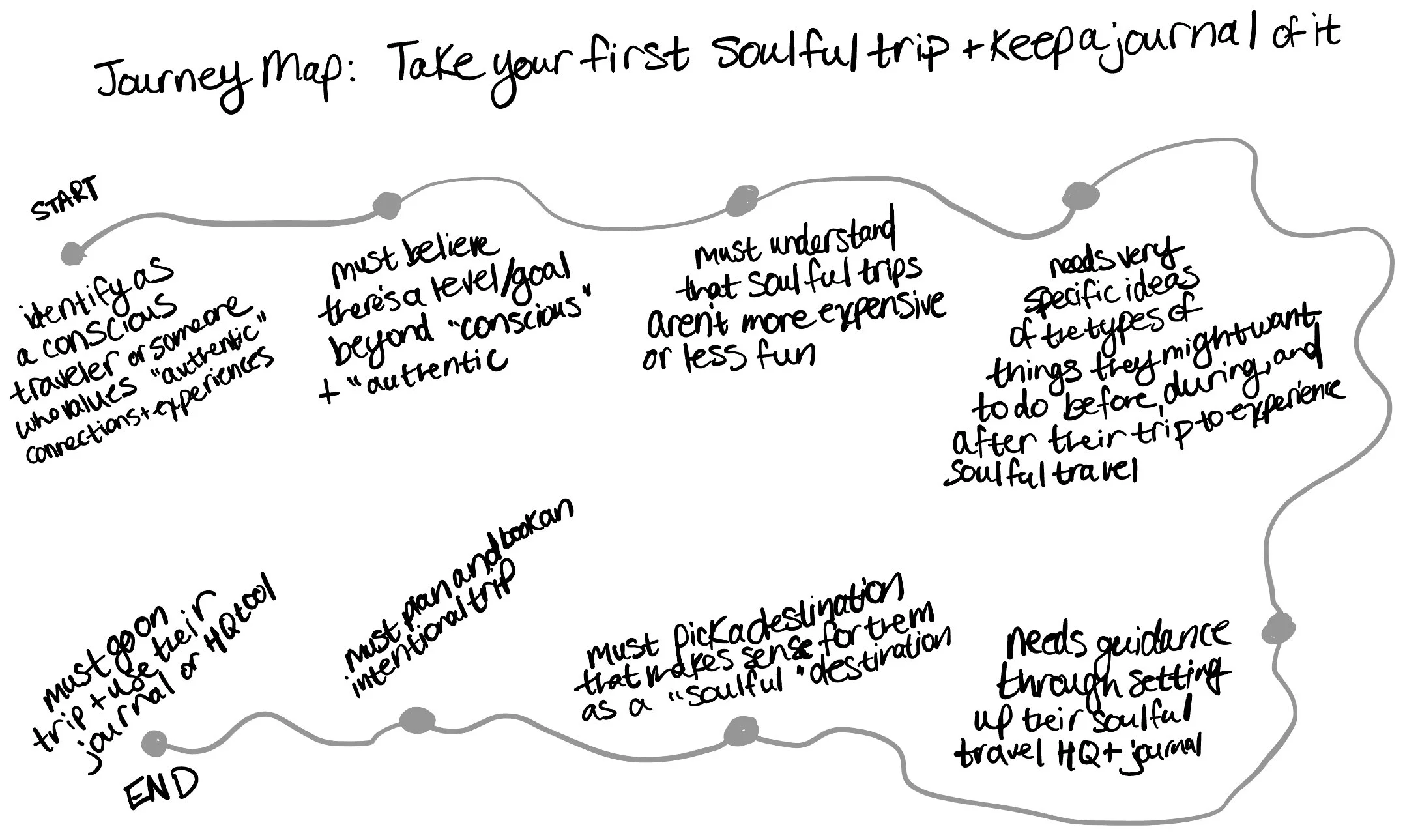
And eventually, this might mean you have “matching” pieces in your body of work that:
Help people form the belief that there is a level or goal beyond “conscious travel” or “authentic travel” . . . and introduce them to a clear definition of “soulful travel” or taking a “soulful trip.”
Guide people through the unique and strategic things they’ll want to do before, during, and after a trip to make it more soulful and meaningful.
Help people set up the sections of their soulful travel journal . . . and get ideas for the types of questions, prompts, and tracking to put inside of it.
Etc.
And keep in mind, some of the points along your journey map will likely be paid products or services. You might host a “Soulful Travel Live” weekend where you take people through setting up their journal, planning their destination, doing some of the prep work for meaningful travel, etc. Or, you might sell a book on the topic, or physical travel journals, or a Notion template, etc.
You get the point.
So, with your journey map(s) taken care of (keep in mind, this was an internal publishing project, you don’t need to share it in public), we can move on . . .
What are some external publishing projects you might want to complete if you’re at this stage?
At this stage, I believe you'll be best served by creating a findable, evergreen "best idea bank." Which is a bank of published work that meets the criteria from earlier:
You feel confident consistently directing people to it
Best-fit clients find their own way to it through search engines, suggestion engines, or AI
It invites people to your email list or online community
But, there are different approaches to creating this bank of pieces. Let's branch off to two main states ↙️↘️ you might be in within this overall "hidden body of work" stage—Stage 2.
Branch/Option A is for you if your body of work and ideas is hidden in past client sessions, conversations at work, or other exchanges that you don't necessarily have transcripts or documentation for. Or, in the cases where you do have transcripts, you haven't organized them and extracted the main insights from them yet.
Option B is for you if your body of work is currently hiding offline in books or workshops you've given in the past, or online in old social media posts or accounts that you haven't touched in a long time, but can still find your way to. Basically, you can download your ideas as slides, copy your ideas from posts, or pull them up as other text-based work.
Branch A: Your work is mainly hidden in past client sessions or other conversations, so you don’t have any/many evergreen pieces published that match up with the key milestones along the journey that you take people through.
For your publishing project, you’ll need to pull up the journey map you made earlier.
Make a list, if you haven’t already, of the multiple points or milestones along the journey you mapped out, including the starting point and the end point. In the example to the right (or below if you’re on mobile), I’d have 8 items on my list. →
Exercise 2A: Create a bank of journey-specific content using question clusters.
In an ideal world, you and I would have chosen the perfect 5 or 8 or 12 stops along the journey in our journey map, and . . . we’d create one perfect piece of content (video, essay, product, etc.) per stop or milestone along that map. Those perfect pieces at each stop would be extremely compelling, and all of our potential clients would read/watch/listen to each piece, in order, and experience a complete transformation.
Which means, in an ideal world, in the case of the fictional conscious travel journey map we’re using as an example . . . our travel thought leader would create:
One perfect video that hypes people up about being “conscious” travelers who seek “authentic” connections and experiences, but it would hint at another way to think of travel and lead people to the next piece, which is a . . .
Video on a different, perhaps deeper, goal beyond “conscious” travel . . . a video that introduces people to the concept, definition, and tenets of soulful travel and trips; and this video would guide people to the next piece . . .
A video on the practical side of soulful trips and how they are NOT more expensive or less fun; they aren’t cumbersome or annoying to plan; this video would link to the next piece . . .
An email course on how to go about planning and executing on a soulful trip, starting with selecting the best destination and community for you, taking time to learn a functional amount of the local language and customs, etc.; this email course would lead to the next piece . . .
A mini product that gives people a template for their soulful travel journal and a digital headquarters where they can plan, keep a digital journal, track their language learning efforts, and more; this product would invite people to a live weekend mini program that includes . . .
A session where members officially pick their first soulful travel destination, and . . .
A session where they plan their trip (with group guidance and feedback and convo) . . . which hopefully leads them to unlocking the last piece of the journey . . .
A last email and video series that goes out to members who are on their first soulful trip; the series offers congratulations, encouragement, prompts, and more to help them make the most of their trip and reflect on what they learned about themselves and the world
So, yeah. In a perfect world, our travel changemaker would have made the pieces above, and the best-fit people would find their way to the first one and go through them all in order and experience transformation.
In the real world, there isn’t always one “perfect piece” for each stop on a journey. And even if there were, you might not be sure about what exactly that piece should say or do.
So instead of putting that kind of unrealistic pressure on yourself (as you transform your “hidden” insights to publicly published ones) . . .
Aim to think through each stop on the journey you outlined and come up with a small cluster of pieces you can publish online that help update your potential clients’ beliefs & skills at that stop -and- help you work out the best things to say or do at each stop.
Specifically, develop question clusters for each stop.
Ask yourself: “What are the most common questions I get about the topic at this stop? What questions are people likely to have as they go through the concepts at this stop?”
Create short pieces online (podcast episodes, videos, reels, carousels, blog posts, etc.) to answer those questions
Let some time pass (and hopefully let some real reactions/feedback come in), and then merge and mature some of your shorter pieces into 2 or 3 longer pieces per stop on your journey map
So for example, Milestone #5 of our conscious travel journey is about providing guidance for a person who wants to set up a soulful travel journal and digital HQ. Our changemaker might list questions people often ask, such as:
“Do I need a travel journal to have a soulful trip? Do I need an HQ? How can they help me be more present, more intentional? How will they help me make better connections? Can they help me honor the people and the land better?”
“Do I take the journal with me on the trip? Will I be pulling it out and recording things in it every few minutes and miss my trip or not be present enough during it?”
“What does a travel journal have in it? What kinds of prompts actually move me to create better experiences while I’m traveling?”
“What kind of sections belong in my HQ? Can it help me not cause harm and extraction in the places I visit?”
Etc.
With these questions decided, our thought leader can create short (or long) pieces exploring them. And eventually, they can combine some of those pieces together and make the final cornerstone essays, videos, and/or products that belong at this stop of the journey.
Note: You don’t need to title your videos, articles, or other pieces as questions, but you can if you think that will work best for your community members.
↓
Branch B: You likely have somewhat crystallized ideas and pieces hiding inside your book or past social media posts, so you already have content that applies to your person at the key milestones along the journey.
If you’ve written a book on your topic, but you don't feel like the work inside of it is very crystallized, go back to option A above and start there when choosing an external publishing project for this stage.
Or if you feel like you have some crystallized ideas (in your book, in past posts on social, etc.), but they don't match the points along the journey or journeys you currently want to take people through, it’s probably a good idea to go back to option A above as well.
If however, you do have crystallized ideas hidden in your past work, and they do line up with the stops along the journey that you want to take people on, then we're going to do something fun.
Exercise 2B: Think through your journey map and identify two things: (One) the part of it that creates the biggest and most empowering “Aha!” for your people, and (Two) the part that you consider the most crucial prerequisite that you want everyone to go through . . . then create a “prerequisite path.”
To make this make sense, let me first start with this thought: What if you knew that everyone who was paying you money for help in your deepest programs came in fully informed, empowered, and with key foundational work already done, because they came from a smaller product that was a meaningful, paid orientation to your approach and philosophies? What if every single person who eventually became your client or joined your deeper program did so because they felt more seen/understood, excited, and positive about your approach than the other options and approaches out there (not just because your offer was at a good price and/or not just because they decided to “take a chance” on it)?
Deciding on a smaller product or service that can function as a “prerequisite product” helps you make sure that everyone who comes to your deeper program not only has a solid foundation & head start, but also truly knows what they’re getting into. They’re not likely to have buyer’s remorse, they’re not likely to become a “problem client” . . . they are more likely to have success on the journey you’ve mapped out, and they are likely to become a productive group member or client, who constantly refers other people to your work.
You’re also getting paid (by this smaller product) as people journey from A to Z with you, instead of only getting paid at point Z.
Since 2021 my prerequisite product has been the program I mentioned at the beginning of this piece—the one where I take changemakers and thought leaders through a specific 4-part process of setting up an “operating system” or headquarters for their meaningful ideas and work.
Here’s the info page for your reference.
This prerequisite has been a favorite of my clients because it helps to strengthen their position & actions on their journey to creating or continuing their impactful body of work. It helps them move in a very strategic way. And it helps them whether they continue that journey with my services/products or not.
On the business side for me, this prerequisite product has ranged in price from $200 to $350 USD and has not only made its own 6 figures of income, but has also led to multiple 6 figures of income from deeper 1:1 and group offers.
So, how might you plan your own prerequisite product and the pieces that will help to market and sell it?
First, return to the journey map you created during Exercise #2.
Second, think of the 2–3 actions, items, beliefs, skillsets, or philosophies that you most want people to have (completed) before they work with you in the deepest capacity you offer.
Third, identify 2–3 points along this journey people often claim are the most empowering “aha” or “unlock” moments for them.
↓ Here’s how we’re gonna use these.
We’re gonna take that list of items/actions/beliefs you identified as “prerequisites” and transform one or more of them into a standalone, “prerequisite product.”
In the example of my work: I know that in order to have a good working relationship with my deepest one-on-one clients or group program members, I need to work with people who:
Are changemakers—people doing meaningful work for the good of others
Are critical thinkers and lifelong learners—they investigate, explore, question, and rework things until they come up with healthier models for themselves and others
Believe in the value of creating long-form evergreen assets over going viral or becoming popular on social media—they are not trying to become influencers
Knowing this, I created a prerequisite product where people come together to make a type of Intellectual Property HQ. Which is a digital operating system they put in place to help them curate and generate high-quality ideas, transform those ideas through critical thought, and publish radically helpful guides for their community from those ideas.
I only work with people who have this foundation. I can't strategize for people who want to become social media superstars. I can't help people who don't deeply care about what they're selling. And I can't help people who aren't selling something that makes the world a safer, healthier, better place. This is for my sanity, not to be snooty. I have a great deal of passion that activates when my client is deeply passionate about what they're doing and why.
What is essential for you to thrive in client relationships? And what’s essential to your clients thriving with your solution? What are the non-negotiable beliefs and skillsets you want a person to have before they work with you in your deepest offers?
Is there a foundational asset you can help them put in place so that your work can go more smoothly?
If so, it's great to design your prerequisite product around a tangible outcome, because it's easier to explain and sell. Note: When creating prerequisite products, I often encourage my clients to create them in the form of workshops/courses, one-on-one sessions, specialized subscriptions, or books. But other formats work as well. So the real questions are: What do you think will be most useful to your people? And what do you feel best about providing?
After you have planned and outlined a prerequisite product, we're gonna create a small bank of 3–5 pieces that lead to that product. These pieces need to be abnormally, ridiculously helpful.
And this is why I asked you to identify 2–3 points along the journey you take people through that your clients often claim are the most empowering “aha” or “unlock” moments for them. If you don't have enough client data to answer that question, you can think about basing it on your own experience through this journey, or you can go back to Exercise 2A and start there.
If you do have enough client data to answer this question, then use the 2–3 points you identify as the basis for these special pieces you’ll create.
I recommend creating at least two pieces per "aha" or "unlock" that you identify. The two pieces will allow you to test different formats and messages to see what's most compelling.
For example, I identified early on that people had a real "aha" moment when I pointed out the sharecropping patterns within social media platforms, and the fact that when we prioritize social media, we are giving our best attention and time to content that depreciates (loses value; and quickly in the case of most social content) instead of content that appreciates (gains value over time) like your average YouTube video or article on your site.
I put these insights into a long-form essay on my site and an organic Instagram post that I ran as an evergreen ad for $5/day for years.
That one essay helped to bring in tens of thousands of dollars from my prerequisite product. As did that Instagram ad (with the help of a couple other evergreen ones that I ran for a few years).
So, imagine if you identify the most compelling “unlock” or “aha” points on the journey, make a couple of evergreen and radically helpful pieces for each of those moments, and then focus on getting people to those pieces.
That's your prerequisite path. If your pieces are search or suggestion engine optimized, or if your pieces are ads, their format helps to bring people to them, without your constant involvement. And if these pieces all invite people to your prerequisite product in a compelling way, they can become your always-on salesperson for your prerequisite.
So, long story long, that's your assignment if you're in position 2B: Create your prerequisite path and product.
—
Either way you go—whether you complete Project 2A or 2B, or an entirely different project you come up with—the goal of your external publishing project at this stage is to create the content that will fill in the journey you want to take people on. Bonus points if you can identify a couple of points on the path where you can sell products or services that help your community and keep your business running profitably.
Stage 3: You’re here if you have a small body of evergreen, helpful pieces that consistently reach the people you created them for and draw them into your email list, community, or products/programs.
You know how to publish helpful things, and you're no stranger to your topic. But, if you're being honest, the number of evergreen pieces you have (that consistently reach the best people for you and consistently bring them onto your email list and into your products or services) is smaller than you'd like it to be.
—
So, what projects take you in the wrong direction? And what projects should you work on?
It feels like the answer should just be "Create more content! Double down!"
If you know how to write/record and you can make good stuff, isn't the goal just to make a lot more of it? (Cue the “100 days of yapping on YouTube challenge” . . .)
I'm going to say no (or rather, not yet), and I’ll tell you my reasons after I share with you what I think a good, first internal writing project might be at this stage.
Exercise 3: Create a table (or other type of file of your choice) that outlines the various things your best-fit client has done, tried, or purchased to help them with the journey they’re on . . . and the results of all of the things they’ve attempted.
So, let’s say you’re like some of my clients who help institutions, corporations, and other organizations improve their workplace culture. Let’s say you specifically work with nonprofits and social good companies, for the purposes of this example.
You’d make the following table:
Start with a column labeled “Solution”; a column labeled “Results and Reasons”; and a column labeled “Beliefs”
Then, add a set of rows for things people have Integrated, a set of rows for things people have Tried (but didn’t or couldn’t integrate fully), a set of rows for things people Obtained (but didn’t really try to work with), and finally a set of rows for things people came across and are Aware Of or have heard about (but didn’t obtain or try).
P.S. You can also just press “File” then “Make a copy” to create your own version (in your Google Drive account) of the spreadsheet below that I already designed for you here.
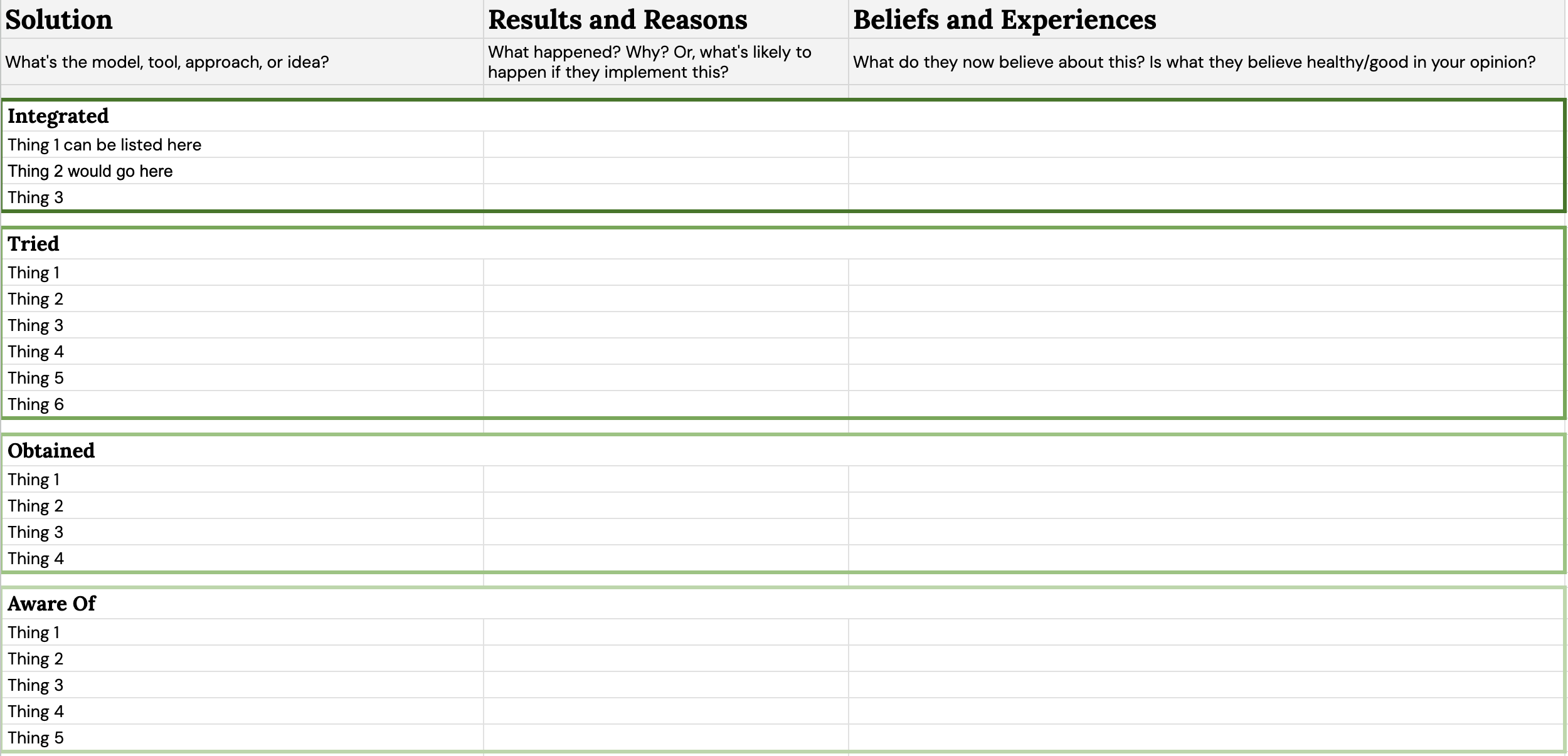
Just one way to do it 👆🏽. Of course, feel free to design your table or outline in a different way.
It might help to think of your rows as a type of engagement gradient . . . if you will. We start from the most engaged end of the gradient (a solution, tool, or model that was truly integrated to the best of your client’s ability), then move to a less engaged spot (where people sorta kinda tried something, but not as deeply as they could have), then continue to a spot where someone has obtained a tool and not used it, and finally land on the other end of the gradient where your client is just aware of a potential solution/tool, but hasn’t obtained or used it yet.
In order to fill out this table:
You’d first start by listing everything you can think of that your best-fit clients or intended community have implemented to a successful degree (in your opinion), even if the results weren’t everything they’d wish. We want to understand what they’ve started and followed through on (to the best of their ability) to make their situation better.
We’ll put these things in the “Integrated” rows. And remember: You’re listing what you know (or highly suspect) your best-fit clients have done. It’s okay if you’re taking an educated guess based on everything you know.
So, you might list things like:
They’ve had executives and leaders read at least one psychological safety book and start leading meetings differently to make sure all members feel comfortable with sharing their opinions and ideas.
They’ve put their whole organization through a DEI workshop series, and they semi-regularly use language they learned in that seminar with each other.
They allow 90% of their team members to work remotely half of the week.
Etc.
After you’ve listed everything you can think of that your people have done, you’ll then record the results of these activities, and why things turned out that way, in the second column. And you’ll note your clients new beliefs and experiences in the third column. Be specific:
What improved and what got worse? Are there areas where things might seem better off than they really are? What types of friction might they be experiencing that suggest this “solution” wasn’t the full answer? In what ways are they much better off? What do they now believe due to the experience of encountering or using this tool, experiment, or solution?
Once you’ve recorded the solutions, results, and beliefs in the “Integrated” category, move on to things that were “Tried.”
We’re specifically identifying things your best-fit clients “sorta” tried, or half implemented. Things that they didn’t work as hard to integrate as they could have.
So you might list:
A virtual trust-building retreat they might have attempted a few years ago during the height of the pandemic . . . a retreat that kind of went nowhere
An initiative they started to pair off or group the team into small clusters of bookclubs, with the intention of people reading leadership/culture/DEI style books and discussing them together to further their learning and culture improvement efforts; but maybe the book clubs fizzled out and no one really does them anymore
Etc.
After you’ve listed everything you know (or are pretty sure) your best-fit clients have tried, make sure to record the results of those attempts as well—including the reasons for those results and new beliefs that cropped up due to those results.
Follow the same process for:
Things your best-fit clients have purchased or “Obtained” (tools, books, programs, equipment, software, gadgets, etc.) to help solve an issue or reach an important goal . . . remember: these are things that they’ve obtained but haven’t tried; if they have really tried to use it, it should go in the “Tried” category, and if they’ve not only tried it, but really stuck with it and did their best, it would go in the “Integrated” category
Things your best-fit clients have come across, heard about, or become “Aware Of” in some way, but haven’t obtained, tried, or integrated yet; for example: they might know about a lean leadership style that they haven’t used, or they may know about a book that outlines a specific model of meeting/working with teammates, but they haven’t bought the book yet, etc.
All in all, you might end with a table like this:
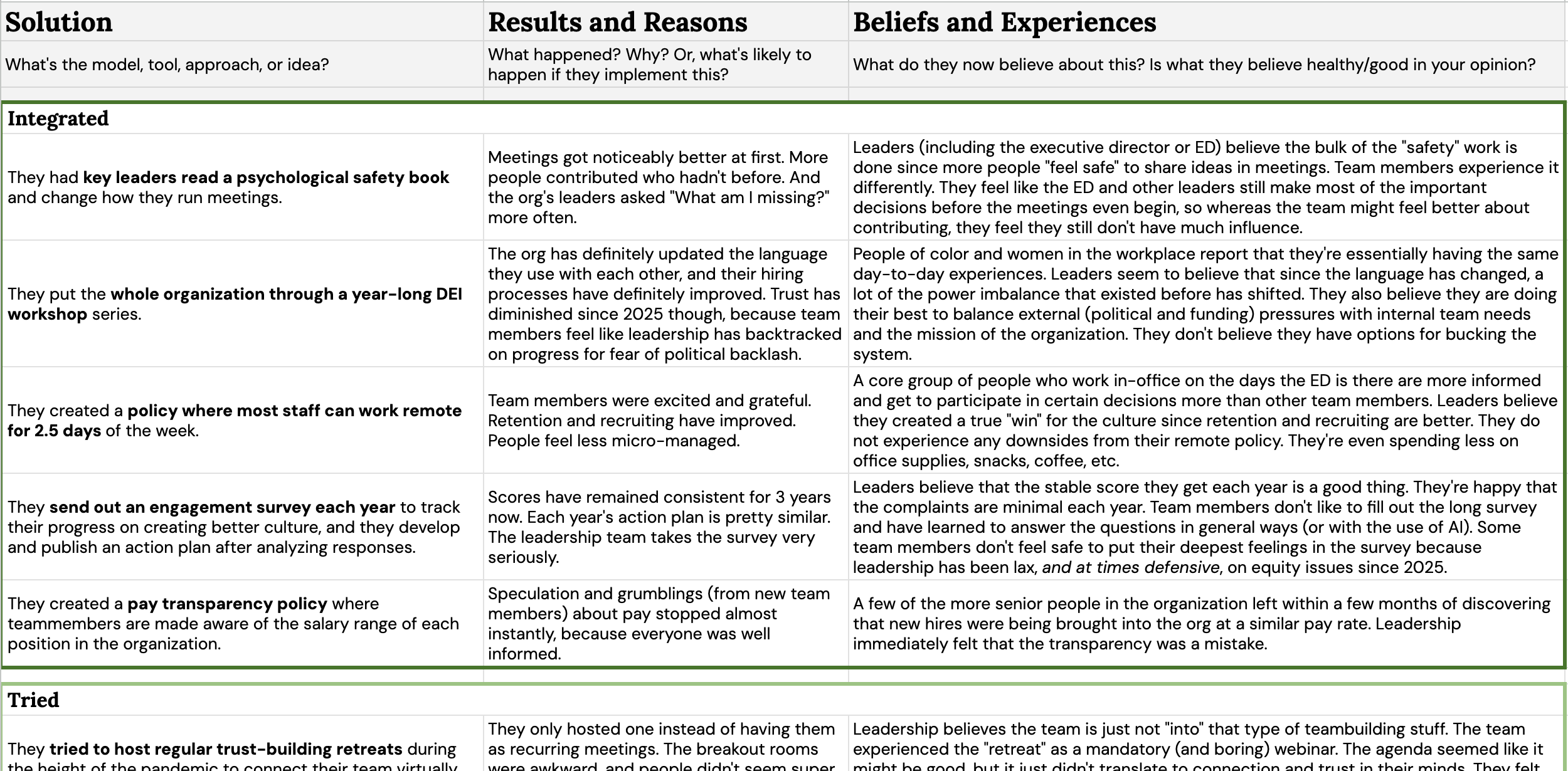
. . . and so on and so forth
—
We’re gonna use this table for the external publishing projects that we’re about to discuss.
But first . . .
Earlier I said that I didn’t think the answer to “What should I do now?” is “Create more content! Double down!” Or, rather I said, I don’t think that’s the answer yet. And that I’d give you my reasons after explaining the internal writing project above.
Here’s the deal:
Best case scenario, when people prescribe 100 days of yapping videos, or 30 days of podcasting, or 90 days of Instagramming, they’re doing so to help you bring people back to your website (or some type of landing page or asset) and give them something they can sit with for a while, and get excited about, as they decide on hiring you or joining your program, right?
The issue is: What are you actually leading people to right now?
If hundreds, or thousands, or tens of thousands of new people came back to your site during your next 30 days of podcasting or Instagramming . . . would they be met with ideas that catch them where they’re at? Ideas that answer the questions they didn’t even ask, but definitely wondered about: “Why didn’t XYZ work? Why haven’t I figured this out already? What is it about these other solutions that hasn’t been healthy or right for me?”
Or, would they get lost on your site and not really know where to go? Would your site blend in with others they’ve been to? Would there be too few compelling pieces to stick around for?
My suggestion is that we first make sure that what you’ll be leading people to (on your site) helps to fill in very specific gaps for them, and then you can activate a 30-, 60-, or 90-day challenge that appeals to you . . . if you want to do one.
So, to make sure your site pieces fill in those gaps, we should talk about the publishing projects you might want to pursue before the 100 days of yapping or carousel-ing. Or before whatever you decide to prioritize next.
What are some external publishing projects you might want to complete if you’re at this stage?
At this stage, it’s a good idea to create an “Alternative Solution Series” that helps your best-fit community members and potential future clients process why certain things don’t work well for them. And how other ideas/solutions might be healthier for them and the specific way their brains, organizations, or lives work.
We’ll take two different approaches ↙️↘️ to creating this series based on which option describes why you’re in this overall "small body of work" stage—Stage 3.
Option A is for you if you’ve published a few evergreen pieces that are doing their job to a certain degree, but you feel they just don’t have enough traction yet.
Option B is for you if you have a small body of work you like, but you feel you’ve become a bit of a format and platform dabbler (you do LinkedIn lives, then LinkedIn articles, then podcast episodes, then Threads for a few days, then website articles, etc.).

Option A: You have a small body of work, but not enough traction yet.
This may be because your pieces simply haven’t existed for very long. Or it may be because your pieces aren’t as strong as you know you can make them. Etc.
Exercise 3A: Angle test how you present your work as an alternative solution . . . and what you’re even claiming it’s an alternative to . . . through a series of 10+ pieces over the course of 8 weeks or more.
If your ideas/pieces don’t have enough traction yet, you need two main things: a significant enough number of compelling pieces (10+) and a long enough time period to track how things land (8+ weeks).
We’re gonna make sure your pieces are compelling by building them from the “Solutions, Results, and Beliefs” Table you made in Exercise 3. And we’ll give them enough time to land, such that if they don't land, we’ll know they’re: (1) not the right angle, (2) not worded in a way your best-fit people can get behind, or (3) published in a place your best-fit people don’t go.
So how do we develop compelling pieces from the table you made in Exercise 3 earlier?
Pull your table back up and review it, with emphasis on the last column (“Beliefs and Experiences”), where you outlined the beliefs your best-fit clients likely now have as a result of the solution they integrated, tried, obtained, or are aware of.
→
We are going to pull themes for, outline, and create pieces from these beliefs and experiences. [Let's keep with the example of someone who helps nonprofits and other do-good organizations improve their culture and communication. Let's assume this person has a year-long program they sell, among other products and services, where they do deep discovery interviews with the whole team, then co-build a trust repair plan with the team. During their year together, they also host management and leadership trainings, along with workshops and retreats for the entire team.]
First, for every belief or experience you filled out in the third column of your table, review it for the purposes of simplifying it into one or two clear statements that your best-fit clients could easily understand.
So for example, if you’re on the row where you recorded the fact that your best-fit clients often send out engagement surveys each year to track their progress on trust and culture repair, you might review the new beliefs and experiences column and make the following statement: “Leaders believe that a stable engagement survey score year over year is good. Team members don’t believe that answering truthfully is safe (or that it will change anything), so they don’t bother. And, they can’t stand that the survey is sent out when they're trying to finish their last tasks before the holiday break.“Next, “respond” to your best-fit clients’ beliefs that you uncovered by creating a new column. In this response, excavate anything that is off about their beliefs or assumptions, and include your strategic/experienced insight on what they need to improve this thing.
For the example above, this new cell might say: “It seems that leaders have a false belief that stable equals good. Stable usually means people aren’t able to bring their full answers or full selves to the survey. Team members have experienced their responses not being considered or used for meaningful change. They are understandably unmotivated to put extra effort into them. If leaders want more accurate survey results, they need to change the way the survey is designed and administered, so that people have more time, more anonymity, and more incentive to answer truthfully.“Now, tie your response (from #2 above) to a key philosophy model, exercise, or framework that you have inside your related resource or program.
In our example, as a part of this person’s year-long program they may have a whole section on how to design and implement quarterly culture surveys in a way that protects your team and draws out real responses.Assess if (from these beliefs and your responses to these beliefs) you have enough valuable insight to create a standalone piece that will be radically helpful to your best-fit clients, even if they do not purchase your deeper program.
If you do, awesome. Make a rough outline of that piece. If you don't, that's okay. Keep your notes because you might end up combining those ideas with the ideas that you get when you're reflecting on a different row of your spreadsheet . . . and perhaps once combined, you'll have enough for a compelling piece.Repeat this process for all the rows in your spreadsheet until you have outlines for several pieces.
At the end of this process, you will hopefully have ideas and starter outlines for 10+ pieces you can create. Examples:
“If you’re workplace culture or engagement surveys get about the same scores and responses each year, it might indicate the following ‘trust breakdown’ . . .”
“Five signs the DEIB trainings you've had your team do have changed the language you use at work, but not the day-to-day experiences of your most vulnerable or under-recognized people.’
And so on . . .
And again, ideally each piece is helpful, useful, and applicable to your best-fit clients, even if they're missing the context of your full program or service. But hopefully, each piece relates to something in your deeper offers such that you can extend an invitation, or suggest a next move through your work.
P.S. After you create your outlines for your 10+ pieces, spread the creation and publishing of those pieces out over the next 8 or more weeks on an evergreen platform you use that you believe you can easily direct people to.
If you already have a YouTube channel or blog that gets a meaningful amount of visits from your best-fit clients each month, then that will probably be your answer. If not, you might decide to publish these pieces in your LinkedIn newsletter, a new YouTube channel, or a Substack publication—a platform where “discovery” happens and where you can publish long-form pieces.
↓
Option B: You have a small body of work, and it feels like it’s staying small because you dabble on too many platforms or create too many formats of content.
You know if this is you, and no shame if it is . . . I feel like we've all been here before.
Exercise 3B: Create 1 long-form “Spark Piece” that frames your alternative solution well and choose 1 platform (where you know you’re people are gathered) where you’ll create mid-length pieces that invite people back to the Spark. And stay there for 8+ weeks.
We’re gonna stop dabbling, put your best “alternative solution” piece front ‘n center on your website (though it can be an embedded audio or video episode), then go one place you’re people are . . . and stay there for a while.
We’re gonna break the process down into its parts, but to get started:
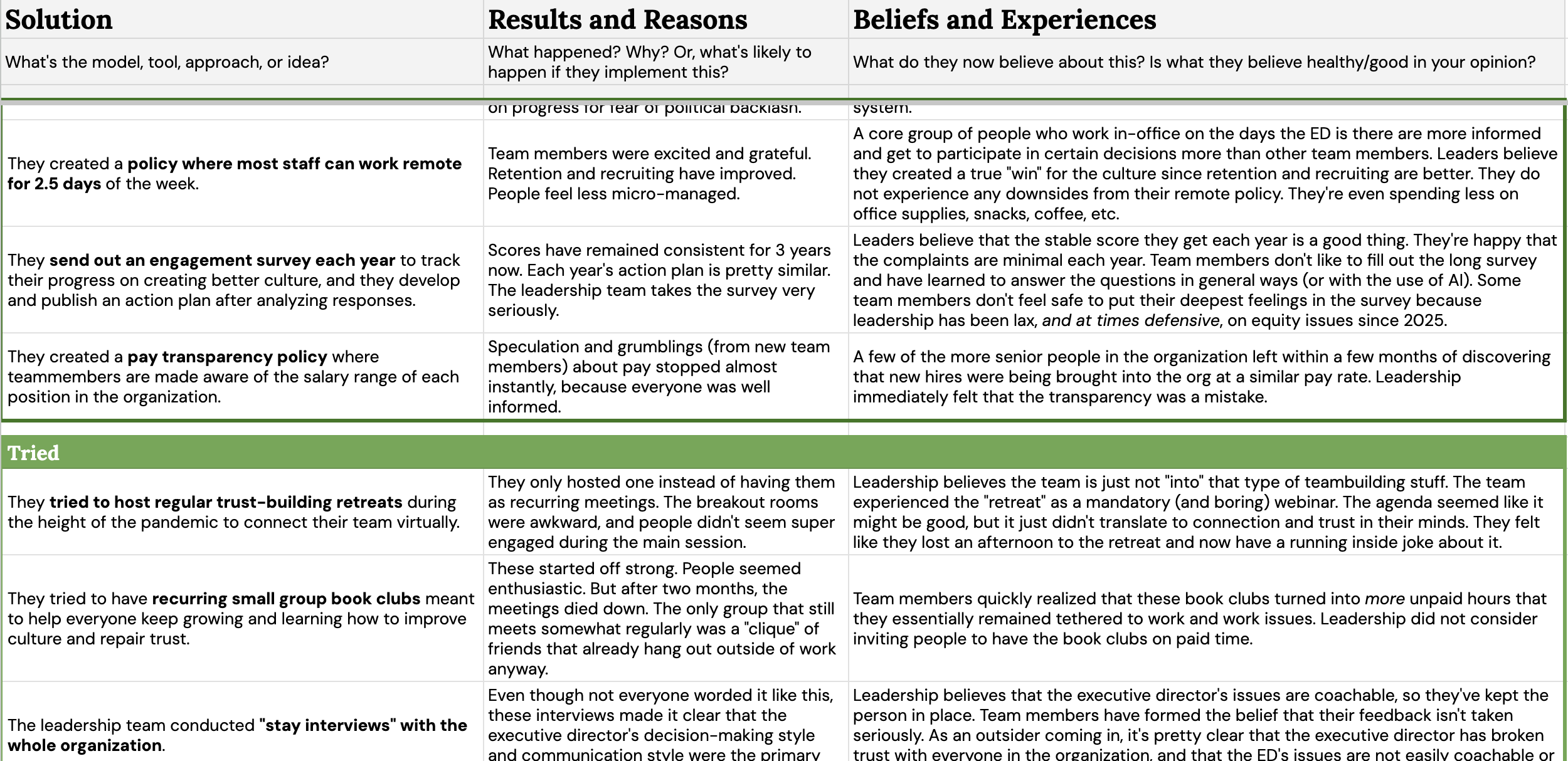
Pull up the “Solution, Results, and Beliefs” table or doc you made earlier in Exercise 3.
Review the column where you recorded what your best-fit clients likely now believe and experience due to the ways they did or did not use the solutions you identified.
Then:
Pull out 3–5 beliefs or experiences that you know you have some critical insights on. We want 3–5 beliefs or experiences that you can respond to, support, and offer perspectives on that are unique to you. Which beliefs/experiences expose something that you have a proprietary model, framework, or philosophy for?
In the example of doing culture work and trust repair at nonprofits: You might have a unique take on what to include in “stay interviews” with a team in order to get to the heart of workplace issues. You might also have a very distinct definition of “psychological safety” that, when you explain it to people, really helps them to carry themselves differently and create more positive conversations at work. Etc.Choose one of the beliefs and the accompanying response/philosophy you want to apply to it. You can also combine two or more of the beliefs and your insights on them into one concept. Either way, outline one single piece that will serve as a “Spark Piece” for people—a piece that sparks new thoughts on how to approach something they’ve been working on for a while.
For example: You might choose your framework for what psychological safety really is and how leaders should approach it differently.To your outline, make sure you add notes on the multiple ways your best-fit client can improve their outcomes (or minimize damage) when adopting your fuller, healtheir model. Make notes of the things that show up on a regular basis in their lives/relationships/workplaces when doing things the old way.
Draft your solo “Spark Piece” and make sure it invites people back to the next move with you that makes the most sense. This might be a “Prerequisite Product” (explained in Project 2B above), but it might also be an email course or 1:1 vetting call. You can publish your Spark Piece as a guide on your site. Or, as a video on YouTube or an episode of your podcast . . . that you embed on a page on your site.
After you have a Spark Piece on your site, move on to the second half of this non-dabbling project, explained below.
Okay, so, at this point you have a shiny new Spark Piece on your website.
Ex: “Psychological Safety Has a Different Definition When You Work for a Non-Profit or Social Good Company . . . Here’s Proof” [this isn’t necessarily the title of the piece, just the theme].
Now, we have to enact our non-dabbling plan. We’re not gonna spend time on 12 different platforms and formats of content.
Instead, you’re gonna select one place your people are . . . and stay there for a while. This place needs to meet a few criteria:
It must be a place where you can create long-form-ish pieces . . . articles of 1,000+ words and videos/audio that lasts 5–20 minutes, or more.
It must be a place that has some built in discovery; meaning: people are likely to have your content suggested to them on this platform, or they’re likely to search for it and find it.
Ex: YouTube, Substack, LinkedIn Newsletter, etc.You should enjoy using this platform, or be undecided but curious about it. This won’t work well if you hate the platform.
The people who make up your best-fit community or potential future clients should regularly use and like the platform.
Once you’ve identified the platform you will use (ex: LinkedIn) and the format you will publish in (ex: articles all under the header of a LinkedIn “Newsletter”), you’re ready for the second half of this 3B publishing project.
Publish medium-length to long-form pieces on this platform for at least the next 8 weeks. Ideally, you’ll publish 8–12 pieces. These pieces should, for the most part, link back to your super duper Spark Piece on your website that you created in part 1 of this exercise.
Hint: If you want help deciding what to publish, check out exercise 3A above as well as exercise 2A for some ideas you might like.
Either way, your publishing over these ~2 or 3 months will be focused (in terms of topic and platform), and will give you time to understand how people respond to your ideas. It will also hopefully consistently direct people to your website and encourage them to interact with some of your best-formed and most crystallized ideas (that you shared in your Spark Piece).
Finally, this project should help your community grow. You’ll likely be connected to many more people who are a good fit for your work after 90 days.
—
Reminder:
The goal of both of the external publishing projects at this stage (3A & 3B) is to publish a small collection of pieces that present your ideas and approaches as viable, strategic, smart “alternative solutions” to the things people try, buy, and think about trying in your industry.
Your “alternative solutions” are designed to help your people—who are on a mission to change, heal, and accomplish important things—to a level that their current actions aren’t reaching.
When you create “alternative solution” pieces and Spark Pieces you’ll have content on your site (and YouTube/Substack/etc.) that mean people know what to know you for and know exactly which pieces to send to friends or colleagues who would benefit from your work.
That is invaluable.
Stage 4: You’re here if you have a large body of evergreen, helpful pieces that consistently reach the people you created them for and draw them into your email list, community, or products/programs.
This is awesome! Congratulations; I know that it was not easy to do what you did.
Question: Do you still feel like your work is “unfinished” or that it would be even more impactful if presented and organized differently? Do you have more you want to codify to shore up the legacy and longevity of all the ideas, thinking, and work you’ve put in over these many, many, many years?
If so, keep reading.
—
What should you work on at this stage? And what projects or goals might take you in the wrong direction?
I have to start by saying . . . that almost more than any other stage in this piece, if you’re in Stage 4, turning to a “100 days of yapping challenge” first (before firming up and organizing things—some of which we discuss below) is probably the worst idea for you. That said, if you’re coming back from a long break away from your work, and a “50 days of carousels challenge” actually feels good and inspiring . . . don’t let me stop you. Go with what feels good.
If challenges like those don’t appeal to you right now, or if you’re curious about some other options, allow me to share what I think is a good idea at this point.
Exercise 4: Revisit the “journeys” that you take people on with your work. Remap them, firm them up, and then organize your website’s blog or library by them.
So that I’m not out here just repeating what I said earlier, please visit Exercise 2 under Stage 2 for instructions on (re)mapping the journeys you take people on.
If you’re like our “conscious” or “soulful” travel thought leader from earlier, you might have four main journeys you help people with:
Creating a soulful travel HQ and journaling system to help people be more present and less extractive when they travel
Booking and taking their first soulful trip, based on a person’s own unique definitions of traveling consciously
Learning a functional amount of a new language in 90 days (with a proprietary system) before people leave for their trip
Storytelling online about their travels, in respectful ways that uplift a people and a place instead of using them as a backdrop for a person’s #travel-influencer-girlie life
Once you have your 3–5 journeys outlined, consider re-organizing the articles on your site under those categories. Or, if you have a podcast or YouTube channel, consider making playlists based on the journeys you decided on.
My potential bookstore is in its infancy stage, so I am following Stage 1 projects for it. My byRegina.com work is over a dozen years old and is in Stage 4. I recently reorganized my library to reflect the main 3 or 4 journeys I work with people on.
Organizing your work under 3 or 4 journeys may be too difficult for you. You may have so much content that you want to organize your library (or YouTube channel) by sub-journeys or pillars within the larger journeys.
So, instead of organizing pieces under a single “publish a sci-fi novel” journey (which includes pieces to help people brainstorm, outline, write, publish, and market a novel), you might organize pieces under:
“worldbuilding for your novel”
“writing an engaging sci-fi book”
“self-publishing or traditionally publishing your novel” and
“marketing for fiction authors”
It’s still one journey in your mind, but you’ve broken it down into sub-journeys to make it easier for people to navigate to the articles that apply to them. Again: this same approach can apply to playlists/shows on your YouTube channel or custom playlists you make from your podcast episodes.
One of my past clients is an amazing relationship coach—I’ve learned so much from her. She organized her hundreds of podcast episodes into playlists like this after realizing that almost 100% of her group and 1:1 clients come to her after devouring hours of her podcast.
Imagine how helpful it would be to find a playlist just for “What to do after trust has been broken in your marriage” or “Been together more than 10 years and feel like you’ve grown into different people?” . . . instead of just one podcast with every episode ever. [Note: These are just my example categories, not the actual ones she chose.]
I’ll probably take this approach too (splitting things into sub-journeys in my library and on YouTube) as I comb through more of my 1,000+ past pieces and update them.
Either way, an excellent, safe, strategic, and helpful starting point is to organize your main work (blog, YouTube, or podcast) into the categories of journeys you take people on.
If you want extra credit, you can even create a guiding statement or “question(s) my work explores” statement for the top of your library or podcast/YouTube channel description.
![Screenshot of the "Library" page on this byRegina[dot]com website](https://images.squarespace-cdn.com/content/v1/64b2902ef6e70e0028f5e56b/73d19e89-8ff9-4520-b66f-54f1754a3be1/Library+Statement+Preview+Screenshot.png)
Think of this ↑ (the categories and the optional guiding statement) as your “internal” publishing project for Stage 4.
When you do this organization-by-journey thing (and assess which pieces you’re proud to put under each journey), you will expose gaps and get a clear understanding of what your next major projects should be. If you just dive in with a “publish for 100 days straight” challenge, it’s easy to miss what you “should” publish next because you’re just focused on what you “could” publish.
You often move too fast and miss things when performing a high quantity of pieces.
Again, if that’s what’s inspiring you right now, and momentum is the goal, go for it.
You know yourself best.
If you want a different type of external publishing project, let’s branch off into two categories:
Branch A will be for you if your thinking on your topic has evolved, and you now feel the desire to go back and update, amend, or add to a lot of your old work. It’s also the branch for you if you’ve been away from your work for a long time and are just now returning to it.
Branch B is for you if you have hundreds or even thousands of long-form entry points into your work (not including social media posts), and you want to organize your body of work more helpfully for people, or codify and shore up more of your work’s legacy.
What are some external publishing projects you might want to complete if you’re at this stage?
At this stage, our goal will be to organize your body of work into the journeys you take people on (as previously discussed above in exercise 4), and then highlight and fill any gaps.
“Gaps?!” Let me explain. Because Branch/Option A has different gaps than Branch/Option B.
Branch A: Even though you’ve been doing this work for a long time, you want to evolve or polish your body of work . . . or return to it after a long break.
Whether you feel like most/all your work needs updates, or just some of it, once you organize your body of work (on YouTube, on your site, etc.) into journeys, some gaps should become apparent.
Think of it like this for a second: What if we wanted every single journey or sub-journey/pillar that you organized your work into, to have an impressive collection or stack of pieces for your best-fit clients to start with?
Let’s call this a “Starter Stack.” And let’s make sure that it has enough variety of pieces (that go to different depths, and approach the journey from different angles) so that all of your best-fit community members can navigate to something that matches their mood, need, and curiosity level.
I’ll offer a suggestion below of all the types of pieces you might want your Starter Stack to have.
Exercise 4A: Outline “Starter Stacks” for each journey in your library (or on your podcast/YouTube channel) and fill in the gaps by creating the missing pieces.
When I work with clients, I help them outline a Starter Stack (for each journey) that consists of:
At least two “spark” or cornerstone pieces that are typically longer and serve as really powerful “start here” options. Meaning: the pieces are so good at introducing people to your unique philosophies and approaches that you’d love it if anyone who wants to [publish a sci-fi novel, repair trust in their workplace, etc.] would start with your cornerstone video, audio, or text-based “spark” pieces.
Examples: “Why Itineraries Tank Your Chances of Soulful Travel” and “There’s Almost No Greater Joy in the World Than Finding Your Soulmate City: Here’s How to Do It”
Examples: “Your Staff if Lying on Their Engagement Surveys, and They’re Right to Do So” or “Your Psychological Safety Changes Made Meetings ‘Nicer’ But Not Safer, Kinder, or Better for Quality Decision-Making: Here’s Why”
At least one series of three+ connected pieces that encourage the person to move from one piece, to the next one, to the next one.
Example: “How to Actually Experience a City (w/ Soulful Travel)”—a set of 3 pieces that breaks down what to do before you go, what to do in your first 24 hours of the trip, and ideas for errands you can run that actually improve your trip
Example: “Why Your Best People Leave Your Nonprofit”—a set of pieces that outline why people say they’re leaving for better money when it’s actually not their real reason, how people leave mentally but are still there physically, and why people leave to get away from 1 of 3 types of executive directors
One challenge or set of guided lessons that your community members can sign up for to get a test drive of one of your frameworks or models.
Ex: “How to Plan a Trip You’ll Remember Forever”—five days of emails where each one helps you replace/complement an item on your itinerary with a soulful travel practice
Ex: “The 4-Day Culture Diagnosis”—a self-assessment & scoring guide that places someone’s nonprofit/organization in one of four patterns, and a follow-up private podcast where one episode drops each day to help them make changes based on any negative culture patterns identified
3—7 supporting pieces that give people more context, share helpful ideas, and direct them to one of your cornerstone pieces or your challenge that people have to sign up for.
Ex: “How to eat alone in a foreign city without feeling sorry for yourself” and “The one question I ask when traveling that always has strangers telling me where they really eat/shop/go” . . . etc.
Ex: “Here’s a five-minute culture fix for your recurring meetings” and “The five communication styles of effective executive directors” . . . etc.
So, imagine outlining a Starter Stack like this for each of the journeys on your YouTube channel or in your website’s library. As you go, the idea is to figure out:
If any of your past work already plugs in, as is.
If any of your past work is a good starting point that just needs some updating.
What you want to create for any spots with missing pieces.
Once you figure that out, your assignment is to fill in your starter stack for each journey.
It’s simple once you have a plan, but not easy.
I believe in you though. Because you believe in the importance of the work you’re doing.
↓
Branch B: You have hundreds or thousands of entry points into your work, and you want people to be able to go through it in a more organized way.
With the number of pieces you've created in the past, my goal for you is that you're not only able to organize your body of work by journey, as we talked about in Exercise 4, and not only able to easily fill past pieces in to your open Starter Stack slots, as described in Exercise 4A . . .
But that once you’ve done those things, you’ll embark on a new project—
Exercise 4B: Create an “ultimate” or “niche” evergreen product for each journey—a product designed to codify your best ideas within each journey and earn money in asynchronous and asymmetrical* ways.
Here’s what I mean:
When you’ve been creating for as long as you have been, at the high level you have been working, then strengthening the lasting impact and legacy of your work is typically your goal.
There comes a point where you either: don’t want to keep working in your current industry (or at least, not at the level you have been), but still want your best ideas and work to help people -or- you still want to work within your current industry, but you want a few more passive (asynchronous and asymmetrical)* streams of income coming from your 10 or 20+ years of experience, and you want to make sure it’s hella easy for people to get directly to your best resources. You don’t want them to have to wade through soooo much stuff on your site/podcast/whatever just to get to the best stuff.
Basically, both of these situations leave you in a place where the goal is probably to codify more and more of your insights.
Let me cover what I mean by “codify” and “asynchronous & asymmetrical.”
When you “codify” your work, you turn the unwritten rules, customs, and processes behind it into organized, helpful frameworks.
Take for example the book Soulful Maximalism** (commission link) by Amber Guyton.
Amber designed interiors for years and years by following certain “rules” that she likely kept track of internally. Perhaps she just instinctually followed them. But, when it came time to communicate, teach, or write a book about her style and process, she had to codify things into frameworks.
She defines “Soulful Maximalism” using what I call a “structural framework”—one where you identify the individual parts that belong in something.
She also helps you figure out what story you want your home to tell (and to design with that story in mind) using a “procedural framework”—one in which you outline the moves necessary to do/make something.
Etc. Etc.
There are multiple frameworks throughout her book. She codified what she’d been doing for a decade into a format that’s clear, organized, and easy for another person to use.
Think about all the client calls you’ve had, the articles you’ve written, or even the videos you’ve yapped on . . . are there things hiding there that you might want to codify and put out in an evergreen product like a book?
Think about the things you’ve already codified into frameworks (inside your consulting offers, conference workshops, courses, and videos or podcast episodes) . . . do you want to update and re-codify some of them in a long-term asset like a book?
That’s what we’ll be talking about for Exercise 4B. Creating an “ultimate” or “niche” nonfiction book that helps you crystallize and codify your most helpful ideas. Don't worry. You don't have to take on a huge project like Amber's Soulful Maximalism book. There are other smaller types of books you can publish. We'll get to that in a second.
*First, let me explain what I mean by asynchronous and asymmetrical income.
[I also made this old video on YouTube about it if you’re interested.]
When you earn synchronous income, you get paid when you do the work. Or, more accurately: you provide value to a person/company in the form of services or other work, and shortly after, you get paid. (Like how many people get paid every two weeks at their jobs.)
When you earn asynchronous income, you do the work one week in May (or the whole month of May), for example, and then you get paid for it in June, and July, and August, and September, and all of Q4 . . . and all of the next year, and so on.
When you get paid is separated from when you do the work.
📌
For example, a few years ago my client wrote a book aimed at nonprofit directors. We outlined and worked on it . . . and she wrote and published it in about six months. She’s been selling it ever since, and just recently made a second edition** (affiliate link).
I expect her second edition to sell for years and years as well.It earns her money asynchronously (at different times than the time she put in the work).
The same happens for me each month with a book I wrote and published in 2014 (it’s an editorial planner called Epic Blog that I plan to update and publish a new edition for soon).
*Symmetrical and asymmetrical income are another story.
When you earn symmetrical income, your income is in essence “balanced” with the amount of work you did. So, if I put in 40 hours of work one week and earn $XXX or $X,XXX for that week . . . I’ve ideally been compensated “fairly” for the amount/effort of work. I didn’t earn tens of thousands or hundreds of thousands of dollars for that 40 hours.
So, symmetrical earning is when your work “matches” your pay.
When you earn asymmetrically for something, there’s a considerable mismatch based on what’s standard or normal. When I use the term “asymmetrical income,” I mean it in a positive way. So it’s not about working for 100 hours and only earning $1 USD (though yes, that is technically asymmetrical) . . . it’s about taking a few hours per week over 3–6 months to write a certain type of nonfiction book, and then earning $100,000+ for that book. Or taking a weekend to record an audio course that you sell for $100 (like one of my clients in higher education) and then earning tens of thousands of dollars from it. Just as an example.
When something earns both asynchronously and asymmetrically, it’s like 🤯.
I prefer these terms to “passive” income, because I feel they’re more accurate. But, if you’re familiar with what people usually mean when talking about “passive” income, then you’re familiar with what I mean by “asynchronous and asymmetrical” income.
Though I don’t know her personally, I think about Chimamanda Ngozi Adichie and one of her books as a great example of this.
Chimamanda has a friend who asked her for advice on raising a daughter in a feminist way. Chimamanda wrote a letter in response (as a Facebook post) with some thoughts and suggestions. And then . . .
She turned it into a book: Dear Ijeawele, or A Feminist Manifesto in Fifteen Suggestions. It’s a short book . . . I think it took me ~30 minutes to read. Remember: the whole book is actually just a letter.
So, let’s say Chimamanda spent (just taking a guess here) several hours writing this letter in 2016. And that she later published it as a print book in March 2017 (which is what happened IRL).
Well:
She has been earning money from this book every month for ~10 years at this point—that’s asynchronous income.
She has also probably earned a considerable amount of money compared to the amount of work she put in writing this letter/book—that’s asymmetrical income.
You get the point. And I've seen this happen with books that did not become national bestsellers, like Chimamanda's book. I've seen it happen for me and my clients time and time again. Nonfiction books actually make great products to sell on the internet to strangers, because most people buy them for the content, not the author.
So now, let me re-share the goal of Exercise 4B:
What if you created one, evergreen product for each major journey you take people on in your body of work? You could create an “ultimate” guidebook like Soulful Maximalism, or a very niche (and small) book like Dear Ijeawele, or A Feminist Manifesto in Fifteen Suggestions.
You have options. And of course, you can create something other than a book too. I’m gonna provide suggestions for types of books below because I think they are products with some of the most potential for asynchronous and asymmetrical income out there.
Also, books are a type of product that most people are familiar with (whereas they may not have purchased a “live cohort group program” or a Notion template before). And books are typically relatively inexpensive products. In other words, books are generally an easier type of product to sell.
They’re also reputation builders. It’s still a feat, and sends a specific message, when you’ve done what it takes to publish a solid and helpful nonfiction book on a meaningful topic.
↓
5 Types of Books You Might Want to Publish
When you think about writing a book, you might think about a huge book that’ll take years and years to complete. But, there are actually several shorter books you can write that will be ridiculously useful to your community.
We're going to go through five types of nonfiction thought leadership books below. When applicable, I'll point out the longer, more “ultimate” options and the shorter, more “niche” options within each category.
Book Type #1: The How-To Guide or Roadmap Book
This type of book outlines the exact moves to make or steps to take, typically in a specific order, to accomplish something meaningful. It provides the roadmap for a specific goal or journey.
Typically, the size of the goal or journey you are helping people with inside your how-to book, and the depth to which you want to cover each part of it, will dictate how big of a book you create.
For example, I own "The Complete Recipe Writing Guide" by Raeanne Sarazen. If the author had just wanted to help people, who are already somewhat familiar with recipe development, to write better recipes (as in: easier to understand for the intended user), then Raeanne could have written a relatively short book.
Instead, she decided to take people through some of the science behind developing recipes, how to modify recipes for plant-based eaters, how to develop recipes for various food allergies and intolerances, how to do accurate and clear writing & editing of the recipes, how to do proper recipe testing, how to do proper nutrition analysis, and even how to style and photograph the food.
She also decided to include multiple helpful appendices and a robust index.
So, she ended with a hefty 406-page book (that’s 8.5×11 inches, by the way). I imagine that she set out to write the “complete” or ultimate recipe writing guide . . . and she nailed it. She covered a lot of things to a great depth.
I’ve also come across (and written) how-to or roadmap style books under 100 pages. How-to books are often short like this for one of two reasons: (one) the author has decided to provide a more high-level overview of how to do something, instead of going into great depth for each section; or (two) the author is giving you a roadmap to something that doesn't have tons and tons of sections, subsections, or steps to it.
If you're writing a user-friendly book on how to set up your first AI tool, and your best-fit reader is someone who doesn't use technology every day for their work, then your book can be somewhat short. I've purchased a couple books like this for my 80-year-old father recently. I like them because they don't try to get into every single thing about AI. It's beneficial for them to clock out after 60 or 80 pages.
Another example of roadmap books I like to share is the book "Podcasting" by Amanda Mayo. The subtitle of it is "How to Start a Podcast and Create a Profitable Podcasting Business."
I like this book as an example because Amanda goes through mapping your podcast, how to bring your content to life, who the best collaborators for your podcast are, the equipment you need, how to set it up, how to launch it, how to market it, and how to monetize it.
This book is 130 pages and serves as a great overview/introduction into what you'll need to do to start a podcast. Over time, as you podcast, you might need to dive deeper on music licensing or interview skills (if you plan to bring on guests), or the marketing and monetization of it, etc. At that time, you might go into deep research mode on YouTube, purchase a course, hire someone to help you, or find a different book that goes in depth on that one topic.
You get the point.
—
Do you have a topic that you could write a helpful overview how-to book on?
What about a topic where you could provide a roadmap to a relatively short journey?
Or, do you have a process or way of doing something that makes you want to create a more ultimate how-to guide?
—
Book Type #2: The Tactical Guide or Playbook
This type of book gives readers “tactics” to try or “plays” they can run/make in order to get better at something meaningful. So, instead of being a roadmap you need to follow in order, playbooks give you options for things you can do, depending on your specific situation or needs.
Hint: This guide you’re reading right now is a playbook. You might eventually use all of the tactics presented (but not at the same time, and not necessarily in order), or you might choose 2 or 3 of the plays to go through over time.
A really common example of a playbook is a cookbook. You can cook some or all of the recipes. You don't have to go through it in order. And it's often organized in some helpful way, to make it easier to find what you need in that moment (ex: splitting the book up into breakfasts, lunches, and dinners -or- appetizers, soups, mains, desserts, etc.).
Here are some examples of different tactical guides or playbooks:
The Psychological Safety Playbook (by Karolin Helbig and Minette Norman) outlines 5 main plays (such as: Design Inclusive Rituals and Manage Your Reactions) with 5 main moves under each play, so . . . 25 total plays. This book doesn't outline a step-by-step process or a specific system for people to follow. Instead, it provides 25 tactics you can turn to over time as a leader in your organization . . . to help you get better at creating psychologically safe environments. P.S. This book is roughly 5×8 inches and 145 pages long.
The Coaching Habit (by Michael Bungay Stanier) goes through seven key questions you can ask, and eight mini lessons on how to use questions, in ways that help you practice better leadership. The 5 ¼ x 7 ½–inch book is a little over 200 pages long.
Dear Ijeawele, or A Feminist Manifesto in 15 Suggestions (by Chimamanda Ngozi Adichie)—the book we talked about earlier—is another great example of a tactical guide. Chimamanda’s 15 suggestions (on how to raise a feminist daughter) are all individual plays that you can make. This roughly 4 ½ x 6 ¼–inch book is 63 pages long.
The length of helpful playbooks ranges from just a few pages all the way up to hundreds of pages. The key defining factor of a playbook is the individual suggestions and ideas that people can take action on. They're not just intellectual arguments, they're something the person can actually put into practice.
Shout out to one of my past clients, Darcy Miller, J.D., who wrote a great playbook.
Bring in Donuts: And 35 Other Sweet Tips to Transform Your Career Today, (affiliate link here) has 3 dozen practical plays under 5 categories (such as Connect, Communicate, and Have Fun) to help early career professionals learn the soft skills that so many people today are missing.
People love her book. “This is the perfect book for a new graduate or anyone looking to connect more at work. Tips, templates, and examples make the advice easy to understand and put into action.“ -An Amazon reviewer
—
Do you have a set of plays or actions you often find yourself sharing with clients and/or doing yourself that would be helpful to others?
Is there something you teach where your goal is helping someone achieve fluency in a thing or get better at a thing, rather than helping someone follow an exact ordered process or get a download of some of your general philosophical arguments?
—
Book Type #3: The Accountability Guide or Coach-in-Your-Pocket Book
This type of book is like a personal assistant, coach, or accountability partner for people working on a specific task or area of life/business they want to improve.
These books often take the form of planners, workbooks, or journals, and offer people the space or reminders to practice, plan, reflect, and answer “the right” questions for their goals.
My best selling book to date fits in this category. It’s a simple, 116-page editorial planner for individuals or business owners who blog. It’s called Epic Blog, and it has a business planning section (among other things) in the front and space to plan out a year’s worth of posts (and track key analytics) in the back. I plan to upgrade it and change the name of it to appeal to folks who are making different formats of thought leadership content.
But, the book has sold well in the decade+ since I published it in 2014. It’s a planner, a tracker, and a mini-coach at times.
There are other formats that fit under this category though. You might want to create:
A workbook, like the “Self-Love Workbook for Black Women” (by Rachel Johnson, LMSW, MFT).
A set of prompts or questions to answer, like “365 Days of Drawing: Sketch and Paint Your Way Through the Creative Year” (by Lorna Scobie).
A devotional or meditation book, where you give the person something to mull over or wrestle with each day/week like a coach might.
A tracker, where people can record their progress and perhaps get little inspirational quotes or exercises on their way to an important goal.
—
Book Type #4: The Distinct Model or Philosophy Book
This type of book shares a key model, philosophy, or methodology you have for achieving a major transformation and/or thinking of oneself, one’s role, or the world differently.
The unique approach you share in your model/philosophy book is typically based on years of experience creating transformation for yourself & others and/or years of researching, writing, debating, teaching, and thinking critically about a topic.
On the long side (books that are longer and probably took a long time to write), you have books like:
The Art of Gathering by Priya Parker (320 pages)
Atomic Habits by James Clear (320 pages)
In the middle (books that aren’t long-long or short-short), you have books like:
The Life-Changing Magic of Tidying Up by Marie Kondo (224 pages)
HBR's 10 Must Reads on Design Thinking (192 pages)
Start Finishing: How to Go from Idea to Done by Charlie Gilkey (245 pages)
On the short side, you have books such as:
Ten Arguments for Deleting Your Social Media Accounts Right Now by Jaron Lanier (150 pages)
We Should All Be Feminists by Chimamanda Ngozi Adichie (48 pages)
Those latter two books are essentially essays (a.k.a. the authors making arguments based on the their unique philosophies). Chimamanda’s book was adapted from a TEDx talk she gave. Both books help to prove that your book can be shorter or more “niche” than what you often think about when you think about writing a thought leadership book.
Note: The book How to Read Now by Elaine Castillo is an example of a book made up of the author’s essays, philosophies, and ideas that fits in the “longer” camp . . . coming in at 314 pages. I say this to say that the type of book (essay/article collection, manifesto, etc.) can be separate from the length of the book.
—
Either way, if you have a specific model, approach, or philosophy, you might want to consider writing a book in this category.
—
Book Type #5: The Lesson Memoir or Personal Experience Book
This type of book is usually a teaching-style memoir, a case study, or a personal essay designed to help someone process through something or do something important.
Some examples:
Let Love Have the Last Word by Common
A 50-page book on healthy living that a past client wrote based on her story and experiences. She was careful to point out that these things worked for her specifically, and that they're not the only way to live. The book had several helpful ideas in it.
P.S. I’ll ask her permission to share her name and the link to her book.The Actor’s Life: A Survival Guide by Jenna Fischer
Creative Quest by Questlove
A 60-page case study I wrote about my first major online program’s launch and sales
The Collected Schizophrenias: Essays by Esmé Weijun Wang (← her book** is a New York Times Bestseller—I’m so proud of this incredible woman!)
Also, just now, as I was looking for a link to my friend Esmé’s book (the Esmé above 👆🏽), I found another book with great reviews by a different Esmé . . . Educating Esmé: Diary of a Teacher's First Year by Esmé Raji Codell. This book also fits into the “lesson memoir” book type.
You probably get the point by now.
—
Do you have a journey you went on that presented you with lessons you believe can be turned into valuable insights for others?
Is there a period of time or an accomplishment in your life that you want to document and teach from?
A lesson memoir or a personal experience book might be a good fit for you, if so.
—
Final note on Exercise 4B: Remember that the goal here is to, over time, think through the best types of books that you can create to codify your experiences, knowledge, and frameworks in each journey that you guide people through . . . and then to publish at least one book per journey.
You might create a how-to book for one of your journeys/pillars, and then a playbook for another one, then a few years later you might follow those up with a lesson memoir for your third pillar, etc.
Of course, you can have more than one book per journey/topic in your work, but I think having at least one is a good way to codify the hard things that you've spent so many years learning, practicing, and teaching.
Congratulations!
If you are the one person, other than me 🤣, who actually read this entire guide all the way through, I don't even know what to say. I should probably give you an award 🥇 of some type, because I know this was a monster guide.
But, for now I’ll just thank you for reading. I hope that this guide helps you and gives you some great ideas as you choose your next, best thought leadership publishing adventure.